
Microsoft Bob
A cartoon house instead of a desktop, sold for one year in 1995
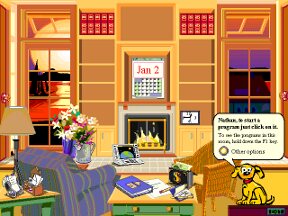
Microsoft Bob was a 1995 Windows shell that replaced the desktop with a cartoon house: click the letter on the desk to write, the calendar on the wall to plan, with animated guides such as Rover the dog offering help. Released on 10 March 1995 at $99 with Melinda French, later Melinda Gates, as its product manager, it sold about 58,000 copies, was overtaken by Windows 95 that summer and was discontinued in early 1996. It is remembered as one of the great flops, and its guides returned as Clippy.
Timeline [edit]
- 1995
-
7 January 1995
Feature
Bob is unveiled at CES
Bill Gates shows a cartoon house with a talking dog.
-
10 March 1995
Launch
Microsoft Bob ships
$99, needs 8 MB of memory and a 486, which most homes do not have.
-
24 August 1995
Decline
Windows 95 launches
The Start button solves the problem Bob was built for.
- 1996
-
1996
Shutdown
Bob is discontinued
About 58,000 copies sold. No second version.
- 1997
-
1997
other
Clippy
The Office Assistant brings the guide idea back, to a similar reception.
- 2020
-
25 November 2020
other
The XP secret is confirmed
Bob had shipped, encrypted, as filler on Windows XP CDs.
How it looked [edit]
The site through time
Browse microsoft.com as it was, via the Internet Archive's Wayback Machine:
Ownership [edit]
Why it shut down [edit]
Official line: Bob sold about 58,000 copies against Microsoft's hopes of millions. It needed a powerful PC for the time, treated adults like children, and Windows 95, released five months after it, made its simplified shell redundant. Microsoft discontinued it in early 1996 without a second version.
Our analysis: Bob was built on a real insight, that most people in 1995 found Program Manager baffling, and answered it with a cartoon living room and a talking dog that made them feel patronised instead. It became the standard example of a software flop, which is unfair in one respect: the ideas, guides that watch what you do and offer help, came straight back as Clippy two years later, and were disliked for the same reasons.
History [edit]
The house
Microsoft Bob shipped on 10 March 1995 for $99. Instead of Windows 3.1's Program Manager, users saw a cartoon house. Rooms held objects, and the objects were programs: a letter-writer on the desk, a chequebook, a calendar, an address book, an email program, a quiz game, a household manager. A guide, by default a dog named Rover, sat in the corner and offered advice in speech bubbles, and there was a range of others, from a rat called Scuzz to a coffee cup, each with a personality. You could redecorate the rooms. The name, and the yellow smiley face with Bill Gates-style glasses on the box, was Microsoft trying to be friendly.
The idea came from research at Stanford on how people respond socially to computers, and the product was managed by Melinda French, who married Bill Gates the year before it shipped. Microsoft pitched it at families buying their first PC.
What went wrong
Almost everything, in public and quickly. Bob needed 8 MB of memory and a 486 when most home PCs had less, so it ran slowly on the machines it was meant for. Reviewers found the metaphor cloying and the guides intrusive, and experienced users found no way to do anything they wanted. Then in August 1995 came Windows 95, whose Start button and taskbar solved the actual usability problem in a way that did not involve a cartoon dog. Sales, according to PC Data, came to about 58,000 copies. Microsoft discontinued Bob in early 1996 and never shipped a second version.
The afterlife of a flop
Bob has been on almost every "worst products" list since, and Microsoft joined in on the joke. But its parts lived on. The Office Assistant that arrived in Office 97, Clippy, was the guide idea in a paperclip; Rover reappeared as the search companion in Windows XP. And in 2020 a retired Microsoft engineer confirmed a long-running rumour: the Windows XP installation CDs had had spare space, and to make pirated copies harder to compress Microsoft filled it with an encrypted copy of Bob. Millions of XP discs shipped with the flop hidden inside.
The domain today
microsoft.com carries no trace of Bob apart from a lifecycle entry in its list of obsolete products, and a 2008 TechNet column by Raymond Chen explaining what happened to it.
Similar projects
 Windows Movie Maker
The free video editor a generation learned on, dropped by Microsoft in 2017
2000–2017
Windows Movie Maker
The free video editor a generation learned on, dropped by Microsoft in 2017
2000–2017
 Google Desktop
Google search for your own hard drive, plus a sidebar of gadgets, retired when the cloud made it pointless
2004–2011
Google Desktop
Google search for your own hard drive, plus a sidebar of gadgets, retired when the cloud made it pointless
2004–2011
 Microsoft Money
Microsoft's personal finance program, eighteen years against Quicken, ended when the banks went online
1991–2009
Microsoft Money
Microsoft's personal finance program, eighteen years against Quicken, ended when the banks went online
1991–2009
 Microsoft Plus!
The boxed add-on pack that gave Windows its themes, Space Cadet Pinball and the first Internet Explorer, sold from 1995 to 2004
1995–2007
Microsoft Plus!
The boxed add-on pack that gave Windows its themes, Space Cadet Pinball and the first Internet Explorer, sold from 1995 to 2004
1995–2007
 Microsoft FrontPage
The web editor that built a generation of home pages, bought from Vermeer in 1996 and retired in 2006
1995–2006
Microsoft FrontPage
The web editor that built a generation of home pages, bought from Vermeer in 1996 and retired in 2006
1995–2006
 Windows Live Writer
The blog editor bloggers loved, from Onfolio to Windows Essentials 2012, abandoned by Microsoft and rescued as open source
2006–2017
Windows Live Writer
The blog editor bloggers loved, from Onfolio to Windows Essentials 2012, abandoned by Microsoft and rescued as open source
2006–2017
Sources [edit]
- The Bob chronicles PCWorld 29 March 2010 [archived]
- Bob, your new best friend's personality quirks The New York Times 17 January 1995 [archived]
- Windows Confidential: Whatever happened to Bob? Microsoft TechNet Magazine (Raymond Chen) 1 July 2008 [archived]
- Retired engineer confesses to role in sliding Microsoft Bob onto millions of XP discs The Register 25 November 2020 [archived]
Last verified: 15 August 2026. Spotted an error? Suggest an edit (corrections with sources are reviewed and applied).