
Sparrow
The mail app people happily paid for, bought by Google and left to rot in the App Store
Sparrow was a mail client for OS X and later iPhone, made by a small French team, that put a Twitter-client interface on top of Gmail and IMAP. It went on sale on 9 February 2011 and was the top paid app on the Mac App Store within a day. Google bought the company on 20 July 2012, development stopped, and the apps were quietly retired.
Timeline [edit]
- 2011
-
9 February 2011
Launch
Sparrow for Mac goes on sale
Top paid app within a day.
- 2012
-
March 2012
Version
Sparrow for iPhone
No push notifications allowed.
-
20 July 2012
Acquisition
Google buys Sparrow
Development stops the same day.
- 2013
-
November 2013
Shutdown
The apps stop working properly
Removed from sale.
How it looked [edit]

The site through time
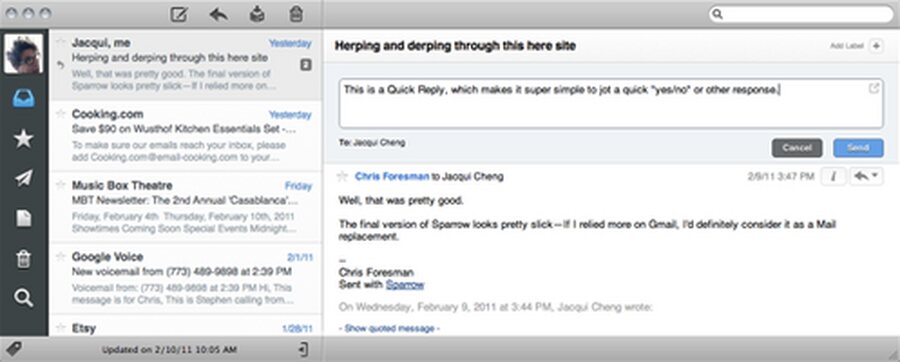
Read the old front page here, in one piece, from our own capture: sparrowmailapp.com, 2 June 2011 →
Browse sparrowmailapp.com as it was, via the Internet Archive's Wayback Machine:
Ownership [edit]
Why it shut down [edit]
Official line: Google bought Sparrow on 20 July 2012 and the team joined the Gmail group. Development stopped the same day apart from critical bug fixes; the apps were pulled from sale and stopped working properly as OS X and iOS moved on. Some of the ideas turned up in Google Inbox in 2014.
Our analysis: Sparrow was the proof that people would pay for a mail client, and then the proof that paying once is not a business. It sold for about ten dollars on the Mac and three on the iPhone, it was the top paid app on the Mac store within a day, and there was no second payment coming from any of those buyers. Apple would not allow push notifications for third-party mail apps without running a server, which the price could not fund. When Google offered money for four people who understood mail interfaces better than almost anyone, the founders took it and told their customers the app would not be developed further. The anger from those customers made the deal a case study in what an acquihire costs the people who bought the product.
History [edit]
Mail that looked like a Twitter client
Dom Leca and Dinh Viet Hoa built Sparrow in Paris on the idea that mail on a Mac did not have to look like a filing cabinet. The window was a narrow list and a message, the way Tweetie showed tweets, with Gmail labels and keyboard shortcuts wired in, drag and drop attachments that could go to Dropbox, and threaded quick replies. After four months of beta it went on sale in the Mac App Store on 9 February 2011 and was the top paid and top grossing app there within a day.
The iPhone version arrived in March 2012 and had the same reception, minus one thing: without push notifications, which Apple did not offer third-party mail apps, you had to open the app to see new mail. Sparrow tried to build the server side that would fix it and found that a one-off App Store price does not pay for a service.
Google buys the team
On 20 July 2012 Sparrow and Google announced the purchase. The team went to the Gmail group, and Leca wrote that the apps would get critical bug fixes but no new features. Paying customers, some of whom had bought both apps weeks earlier, said loudly that they had been left holding software with no future, and the phrase acquihire got its most public airing. The apps stayed on sale for a while, then disappeared; on newer versions of OS X and iOS they broke, and by late 2013 Sparrow was not usable as a daily mail client.
Two years later Google shipped Inbox by Gmail, which several reviewers noted had Sparrow\'s fingerprints on it. Dom Leca left Google and later built Ok Alone and the mail app Spark competitor Sunrise, no relation to the calendar.
The domain today
sparrowmailapp.com is gone. Nothing of the app is available from Apple.
Similar projects
 Inbox by Gmail
Google's attempt to replace its own mail app, loved by the people who used it and closed after four and a half years
2014–2019
Inbox by Gmail
Google's attempt to replace its own mail app, loved by the people who used it and closed after four and a half years
2014–2019
 Yahoo Groups
Where the internet organised itself
2001–2020
Yahoo Groups
Where the internet organised itself
2001–2020
 Inbox by Gmail
The better Gmail that Gmail ate
2014–2019
Inbox by Gmail
The better Gmail that Gmail ate
2014–2019
 Mailbox
The email app with the famous reservation queue, bought by Dropbox for about $100 million and shut down three years later
2013–2016
Mailbox
The email app with the famous reservation queue, bought by Dropbox for about $100 million and shut down three years later
2013–2016
 Windows Live Mail
The free desktop mail program that replaced Outlook Express, cut off from Outlook.com in 2016 and left to die in 2017
2007–2017
Windows Live Mail
The free desktop mail program that replaced Outlook Express, cut off from Outlook.com in 2016 and left to die in 2017
2007–2017
 Vine
Six seconds, looped forever
2013–2017
Vine
Six seconds, looped forever
2013–2017
Sources [edit]
- Sparrow (email client) Wikipedia 1 January 2024 [archived]
- Google acquires Sparrow The Verge 20 July 2012
- sparrowmailapp.com in the Wayback Machine Internet Archive 1 January 2012
Last verified: 31 August 2026. Spotted an error? Suggest an edit (corrections with sources are reviewed and applied).