
Twitter Fleets
Twitter's disappearing posts, built to make quiet users braver, dead in under nine months
Fleets were Twitter's version of stories: text, photos or video posted to a row of circles at the top of the timeline, visible for 24 hours and then gone. Tested in Brazil, Italy, India and South Korea from March 2020, they launched worldwide on 17 November 2020 and were removed on 3 August 2021 after Twitter said the audience it had built them for never used them.
Timeline [edit]
- 2020
-
4 March 2020
other
Fleets tested in Brazil
Italy, India and South Korea followed.
-
17 November 2020
Launch
Fleets launch worldwide
Servers struggled on the first day.
- 2021
-
June 2021
Feature
Advertising inside Fleets
-
14 July 2021
Shutdown announced
Twitter posts Goodbye, Fleets
-
3 August 2021
Shutdown
Fleets are removed
How it looked [edit]
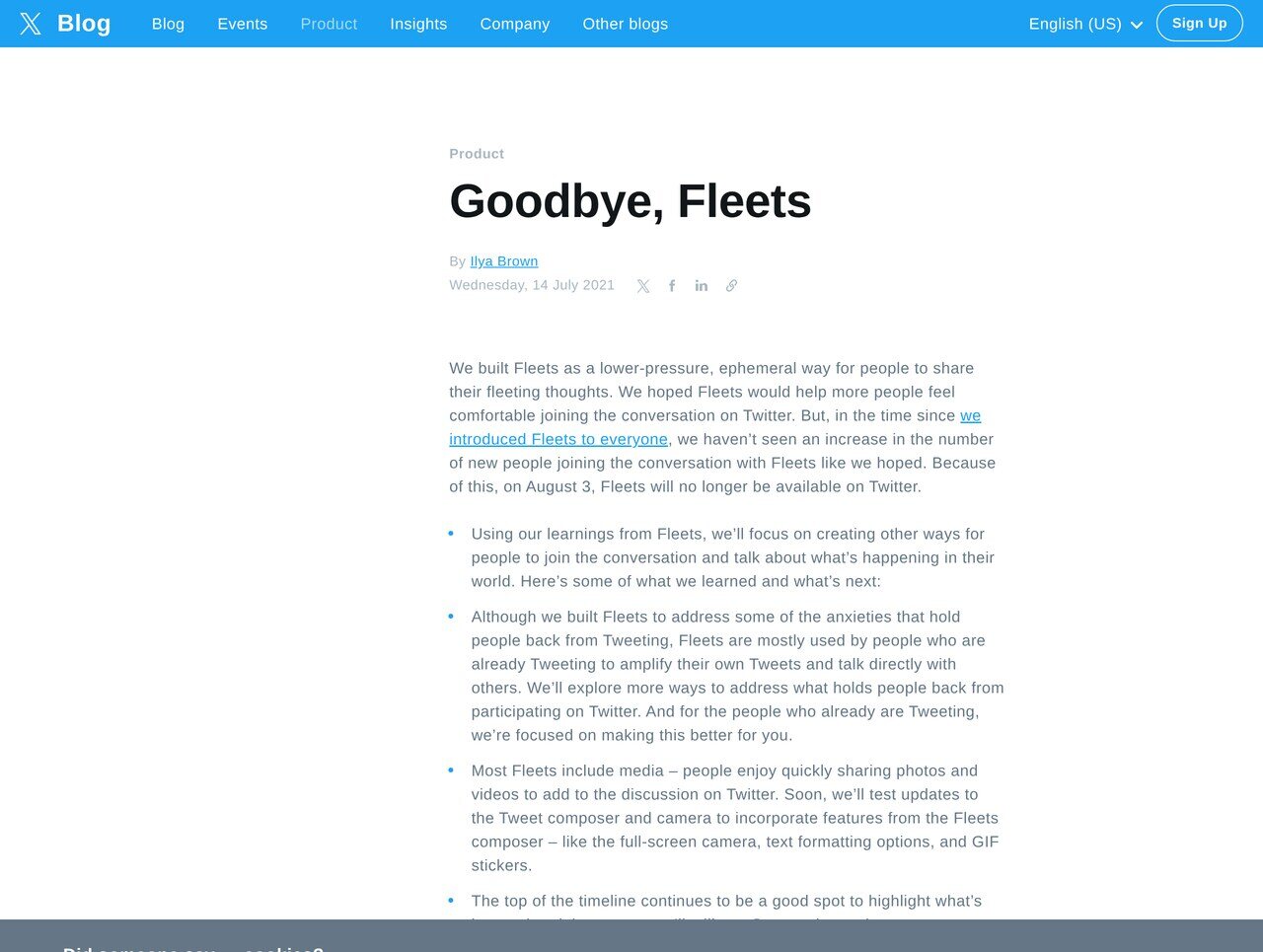
The site through time
Browse twitter.com as it was, via the Internet Archive's Wayback Machine:
Ownership [edit]
Why it shut down [edit]
Official line: Twitter announced on 14 July 2021 that Fleets would be removed on 3 August 2021. It said the people it had built the feature for, users who hesitate to tweet, had not started using it, and that Fleets had not increased the number of people joining conversations.
Our analysis: Fleets misread why people are quiet on Twitter. The theory was stage fright: a post that vanishes after 24 hours should feel safer than a permanent tweet. The actual reason people hesitate on Twitter is the audience, not the permanence, and a Fleet went to the same followers. Worse, the feature landed at the top of the timeline where the eye expects new tweets, so the loudest complaint was not that Fleets were useless but that they were in the way. Twitter deserves some credit for killing it in nine months instead of defending it for years.
History [edit]
Stories, for people who were scared of tweeting
Twitter had a long-standing problem: most accounts read and never post. Its explanation was that a tweet is permanent, public and searchable, and that this makes people freeze. Fleets were the answer. Announced as a test in Brazil in March 2020 and rolled out worldwide on 17 November 2020, a Fleet was a short post, text or an image or a video, that appeared in a row of circles above the timeline and disappeared after 24 hours. There were no likes, no retweets and no public replies; people could only respond in a direct message.
The launch went badly in the ordinary way that launches go badly: the servers buckled under the load on the first day, and the reaction from existing users was mostly irritation that a row of circles had appeared on top of a timeline they had spent a decade arranging.
Nine months
Twitter kept building. It added stickers, backgrounds and, in June 2021, advertising inside Fleets, which is normally the sign a feature is expected to live. Then on 14 July 2021 it posted a note titled Goodbye, Fleets: the feature would be removed on 3 August. The reason given was plain and slightly sad. The people Fleets had been made for, the ones who hesitate before tweeting, had not used them; the people using them were the accounts already tweeting all day.
Twitter said it would take what it had learned into other parts of the service, and some of it did survive: the full-screen composer and the camera work turned up elsewhere in the app, and Spaces, launched in the same period, kept the row at the top of the timeline that Fleets had introduced.
The domain today
twitter.com is now x.com, and nothing of Fleets remains in the app. The row of circles at the top of the timeline was reused for Spaces.
Similar projects
 Friendster
The social network that came first
2002–2015
Friendster
The social network that came first
2002–2015
 MySpace
A place for friends
2003–now
MySpace
A place for friends
2003–now
 Orkut
Brazil's living room, built in a 20% project
2004–2014
Orkut
Brazil's living room, built in a 20% project
2004–2014
 Yik Yak
Anonymous, local, and impossible to moderate
2013–2017
Yik Yak
Anonymous, local, and impossible to moderate
2013–2017
 Google+
The social network everyone was signed up to and nobody used
2011–2019
Google+
The social network everyone was signed up to and nobody used
2011–2019
 Miiverse
Nintendo's hand-drawn social network
2012–2017
Miiverse
Nintendo's hand-drawn social network
2012–2017
Sources [edit]
- Goodbye, Fleets Twitter (X) Blog 14 July 2021 [archived]
- Twitter is shutting down Fleets on August 3, citing low usage TechCrunch 14 July 2021 [archived]
- Twitter is killing Fleets Variety 14 July 2021 [archived]
- Twitter is closing its Stories clone Fortune 14 July 2021 [archived]
Last verified: 18 August 2026. Spotted an error? Suggest an edit (corrections with sources are reviewed and applied).