
CompuServe
The internet before the internet
CompuServe was the first major consumer online service, opened to the public in 1979: email, forums, chat, stock quotes and file libraries a decade before the web. AOL bought it in 1998 and finally shut the original service, by then CompuServe Classic, on 1 July 2009.
Timeline [edit]
- 1979
-
24 September 1979
Launch
MicroNET opens to consumers
Spare timesharing capacity is sold to home computer users.
- 1980
-
21 February 1980
Feature
CB Simulator launches
The first widely used consumer online chat.
- 1987
-
15 June 1987
Feature
CompuServe publishes the GIF format
Its most durable contribution to the internet.
- 1995
-
1995
Peak
Around three million subscribers
The height of the walled-garden online era.
- 1998
-
31 January 1998
Acquisition
AOL acquires CompuServe
The subscriber base moves to the market leader.
- 2009
-
15 April 2009
Shutdown announced
AOL announces the closure
CompuServe Classic will end after 30 years.
-
1 July 2009
Shutdown
CompuServe Classic shuts down
The first consumer online service ends.
How it looked [edit]
The site through time
Read the old front page here, in one piece, from our own capture: compuserve.com, 6 January 1997 →
Browse compuserve.com as it was, via the Internet Archive's Wayback Machine:
Ownership [edit]
Key figures [edit]
| Metric | Value | As of | Confidence |
|---|---|---|---|
| Registered accounts ▲ | 3 million | 1995 | Reported Approximate peak subscriber count |
Confirmed official figures · Reported media, cites a source · Estimated analyst or our estimate
Why it shut down [edit]
Official line: AOL shut down the original CompuServe Information Service, by then called CompuServe Classic, on 1 July 2009, after thirty years of operation.
Our analysis: CompuServe invented much of online life (email, forums, chat, file libraries, online news) and then lost to the open internet it had made people want. AOL bought it for its subscribers, not its future, and let the original service run down to a handful of holdouts before switching it off.
History [edit]
Life before the web
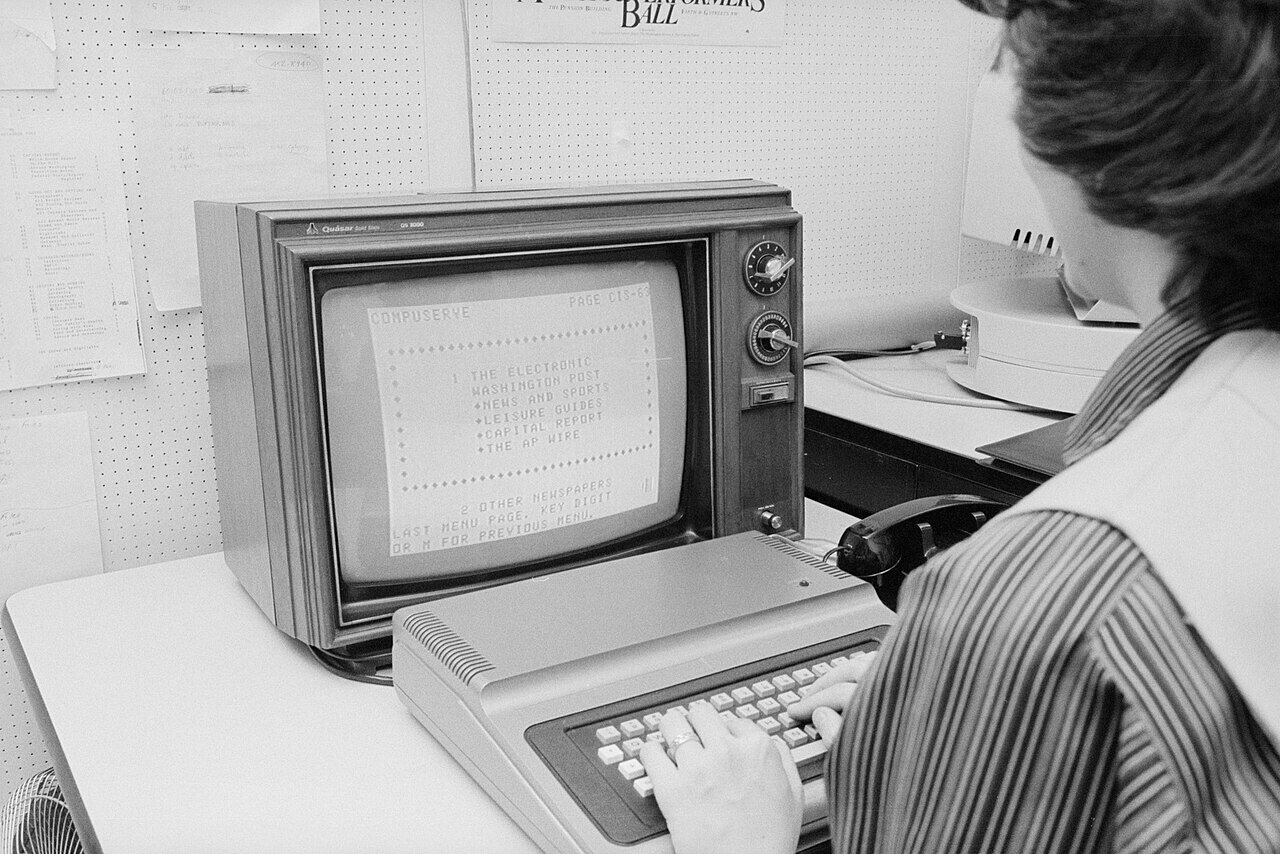
CompuServe began as a timesharing company in Columbus, Ohio, and in September 1979 started selling spare overnight computing capacity to home users. What they got was extraordinary for the time: electronic mail (CompuServe pioneered consumer email), CB Simulator chat in 1980, thousands of moderated forums, downloadable software libraries, airline reservations, stock quotes and wire news, all reached by dialling a local number and paying by the hour.
Users had numeric addresses like 70003,1234, and communities formed around every conceivable topic; for professionals and hobbyists in the 1980s, CompuServe was the online world. The company also gave the world the GIF format in 1987, which outlived everything else it built.
Overtaken by what it taught people to want
The service peaked around three million subscribers in the mid-1990s, then collided with two forces at once: AOL's friendlier, flat-rate mass-market approach, and the open internet, which made any single walled garden look small. In 1998 AOL acquired CompuServe in a complicated deal with WorldCom, keeping the subscriber base.
Under AOL it became a low-cost dial-up brand, its original service renamed CompuServe Classic, running on ancient infrastructure for a dwindling loyal user base. AOL announced the end in April 2009 and closed it on 1 July 2009. The email domain and a portal lingered on for years, but the service that had taught America to go online had stopped thirty years after it started.
The domain today
compuserve.com still works, and still says CompuServe at the top. What it serves is a news portal run on AOL's infrastructure, which is what the brand became after the original service closed in 2009. The dial-up network, the forums and the numeric addresses described here are gone.
Similar projects
 AOL Dial-Up
The modem noise stopped, AOL did not
1991–2025
AOL Dial-Up
The modem noise stopped, AOL did not
1991–2025
 Google Sidewiki
A comment box Google bolted onto every website in the world, whether the owner wanted it or not
2009–2011
Google Sidewiki
A comment box Google bolted onto every website in the world, whether the owner wanted it or not
2009–2011
 Springpad
The smart notebook that turned everything you saved into something useful, loved by five million people and unable to pay for itself
2008–2014
Springpad
The smart notebook that turned everything you saved into something useful, loved by five million people and unable to pay for itself
2008–2014
 Hipmunk
The flight search that sorted by agony, bought by a corporate expense company and switched off while its founders were trying to buy it back
2010–2020
Hipmunk
The flight search that sorted by agony, bought by a corporate expense company and switched off while its founders were trying to buy it back
2010–2020
 Amazon Drive
Amazon's cloud locker, unlimited for $60 a year until it was not, closed at the end of 2023 in favour of Amazon Photos
2011–2023
Amazon Drive
Amazon's cloud locker, unlimited for $60 a year until it was not, closed at the end of 2023 in favour of Amazon Photos
2011–2023
 Pocket
Eighteen years of saved-for-later, gone before you read it
2007–2025
Pocket
Eighteen years of saved-for-later, gone before you read it
2007–2025
Sources [edit]
- CompuServe Classic, a relic of the dial-up days, finally bites the dust The Christian Science Monitor 6 July 2009 [archived]
- CompuServe Shuttered By AOL InformationWeek 6 July 2009 [archived]
Last verified: 11 August 2026. Spotted an error? Suggest an edit (corrections with sources are reviewed and applied).