
Joost
The Skype founders' peer-to-peer television, the most hyped video start-up of 2007, sold for parts in 2009
Joost was an internet television service from Skype and Kazaa founders Niklas Zennström and Janus Friis, announced as The Venice Project in 2006, renamed Joost on 16 January 2007 and opened to everyone on 1 October 2007. It streamed licensed full-length shows from Viacom, CBS and others through a peer-to-peer desktop client, later a Flash website. After Hulu overtook it, Joost gave up on consumers on 30 June 2009 and was sold to Adconion on 24 November 2009; the service was switched off in 2012.
Timeline [edit]
- 2006
-
26 October 2006
other
The Venice Project revealed
Skype founders confirm an internet TV service.
- 2007
-
16 January 2007
Launch
Renamed Joost, invitation beta
Peer-to-peer full-screen TV in a desktop client.
-
20 February 2007
Feature
Viacom deal
MTV, Comedy Central and Paramount content.
-
10 May 2007
Funding
$45 million round
Sequoia, Index, CBS, Viacom, Li Ka-shing.
-
1 October 2007
Launch
Open to the public
Version 1.0, a million beta users claimed.
- 2008
-
17 December 2008
pivot
Peer-to-peer client dropped
Joost becomes a Flash website.
- 2009
-
30 June 2009
Shutdown announced
Layoffs; consumer service abandoned
Volpi steps down; white-label platform strategy.
-
24 November 2009
Acquisition
Assets sold to Adconion
Joost as a company ends.
- 2012
-
9 May 2012
Shutdown
Folded into smartclip
The site had been suspended at the end of April 2012.
How it looked [edit]

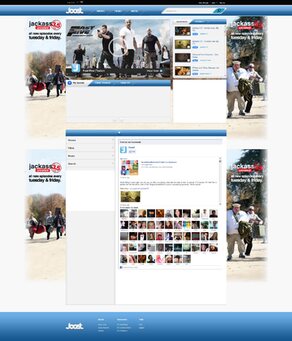
The site through time
Read the old front page here, in one piece, from our own capture: joost.com, 2 June 2008 →
Browse joost.com as it was, via the Internet Archive's Wayback Machine:
Ownership [edit]
Key figures [edit]
| Metric | Value | As of | Confidence |
|---|---|---|---|
| Registered accounts ▲ | 1 million | 1 October 2007 | Reported Beta users claimed by Joost at the public launch |
Confirmed official figures · Reported media, cites a source · Estimated analyst or our estimate
Why it shut down [edit]
Official line: On 30 June 2009 Joost laid off most of its staff, dropped its consumer service as a priority and said it would become a white-label video platform for other companies; chief executive Mike Volpi stepped down. Its British subsidiary went into liquidation in October 2009 and on 24 November 2009 Adconion Media Group bought what was left. Adconion quietly suspended the Joost service at the end of April 2012 and folded the remains into its smartclip advertising unit on 9 May 2012.
Our analysis: Joost had the founders of Kazaa and Skype, $45 million from Sequoia, Index, CBS and Viacom, and a technically clever peer-to-peer client that delivered full-screen television at a time when YouTube was still 320 pixels wide. What it did not have was the content people wanted, an open web presence (it lived in a downloadable app until December 2008) or a way to compete with Hulu, which arrived in March 2008 with the studios as owners rather than licensors. Its rights deals were also territorial, so most of the world saw an empty guide.
History [edit]
The Venice Project
Having sold Skype to eBay for $2.6 billion in 2005, Niklas Zennström and Janus Friis turned to television. Their new company, run out of Leiden and Luxembourg with engineers in London and New York, was codenamed The Venice Project through 2006 and used the same peer-to-peer plumbing as Kazaa and Skype to push near-broadcast quality video to a desktop client with a full-screen, channel-flipping interface. On 16 January 2007 it got its name, Joost, and a wave of press that treated it as the future of TV.
Content deals followed fast: Viacom (MTV, Comedy Central, Paramount) in February 2007, CBS, Warner Music, Sony Pictures, Sports Illustrated and hundreds of smaller channels. In May 2007 it raised $45 million from Sequoia Capital, Index Ventures, CBS, Viacom and Li Ka-shing, and in June it hired Cisco veteran Mike Volpi as chief executive. Joost opened to the public without invitations on 1 October 2007, claiming a million beta users, and NBC and Turner were on board by year end.
Hulu, and the long retreat
The trouble was that Joost was a download when video had become a web page. Hulu launched in March 2008 in the browser, owned by NBC and Fox and stocked with their shows; Joost had licences to older material and territorial restrictions that left most non-US users with little to watch. In December 2008 Joost abandoned the peer-to-peer client for a Flash website, but by then its US traffic was a fraction of Hulu's and Viacom had let its deal lapse.
On 30 June 2009 Joost laid off most of its staff, Volpi stepped down (he had joined Index Ventures) and the company said it would sell its platform to media companies rather than run a consumer service. Joost UK went into liquidation in October 2009, with a public dispute over Volpi's move to Index and its investment in Zennström and Friis's next start-up, Rdio. On 24 November 2009 Adconion Media Group acquired the assets. The site limped on as a video portal until Adconion suspended it at the end of April 2012 and, on 9 May 2012, merged the remains into smartclip.
The domain today
joost.com does not resolve.
Similar projects
 Vine
Six seconds, looped forever
2013–2017
Vine
Six seconds, looped forever
2013–2017
 Justin.tv
One man's life stream that became Twitch
2007–2014
Justin.tv
One man's life stream that became Twitch
2007–2014
 Periscope
Live from anywhere, until the money ran out
2015–2021
Periscope
Live from anywhere, until the money ran out
2015–2021
 Musical.ly
The lip-sync app that became TikTok
2014–2018
Musical.ly
The lip-sync app that became TikTok
2014–2018
 Blip
Where web series lived before YouTube channels, bought by Maker Studios and deleted a year later
2005–2015
Blip
Where web series lived before YouTube channels, bought by Maker Studios and deleted a year later
2005–2015
 Veoh
The video site that beat Universal in court, went bankrupt two months later, and then took fourteen more years to actually die
2005–2024
Veoh
The video site that beat Universal in court, went bankrupt two months later, and then took fourteen more years to actually die
2005–2024
Sources [edit]
- Skype founders' next venture: Internet TV NBC News (Associated Press) 16 January 2007 [archived]
- Venice Project launch name: Joost TechCrunch 15 January 2007 [archived]
- Joost partners with Diversion Media Mashable 20 March 2007 [archived]
- Cisco veteran joins Joost The Guardian 5 June 2007 [archived]
- Eros links with Joost Variety 9 October 2007 [archived]
- Joost officially launches TechCrunch 1 October 2007 [archived]
- Joost free video-sharing service opens to public CBC News 1 October 2007
- Joost CEO: we've figured it out this time Business Insider 17 June 2008 [archived]
- More dramatic developments after the liquidation of Joost UK The Guardian 14 October 2009 [archived]
- Joost is now officially dead: assets acquired by Adconion Media Group TechCrunch 24 November 2009 [archived]
- Final nail in the Joost coffin: Adconion rebrands, folds video service into smartclip TechCrunch 9 May 2012 [archived]
Last verified: 16 August 2026. Spotted an error? Suggest an edit (corrections with sources are reviewed and applied).