
Kazaa
The post-Napster free-for-all
Kazaa was the file-sharing network that inherited Napster's crown in 2001, built by Niklas Zennström and Janus Friis on their FastTrack protocol and famously bundled with adware. Sued worldwide, its operator Sharman Networks settled for over $100 million in 2006 and went legal; the service faded out around 2012.
Timeline [edit]
- 2001
-
March 2001
Launch
Kazaa launches on FastTrack
Decentralised P2P; no central server to shut down.
- 2002
-
January 2002
Acquisition
Sold to Sharman Networks
Ownership moved offshore amid Dutch litigation.
- 2003
-
2003
Peak
The world's most downloaded software
Kazaa Media Desktop tops download charts for years.
- 2004
-
6 February 2004
Legal
Australian raids on Sharman Networks
Music-industry investigators raid Kazaa's Sydney offices and homes of executives.
- 2005
-
27 June 2005
Legal
MGM v. Grokster reshapes P2P liability
The US Supreme Court's inducement standard leaves FastTrack-style networks legally doomed.
-
5 September 2005
Legal
Australian court rules against Sharman
Kazaa found to authorise copyright infringement.
- 2006
-
27 July 2006
Legal
Kazaa settles for over $100 million and goes legal
Global settlement with the major labels.
- 2012
-
2012
Shutdown
The legal Kazaa service quietly disappears
The subscription reboot never found an audience.
How it looked [edit]
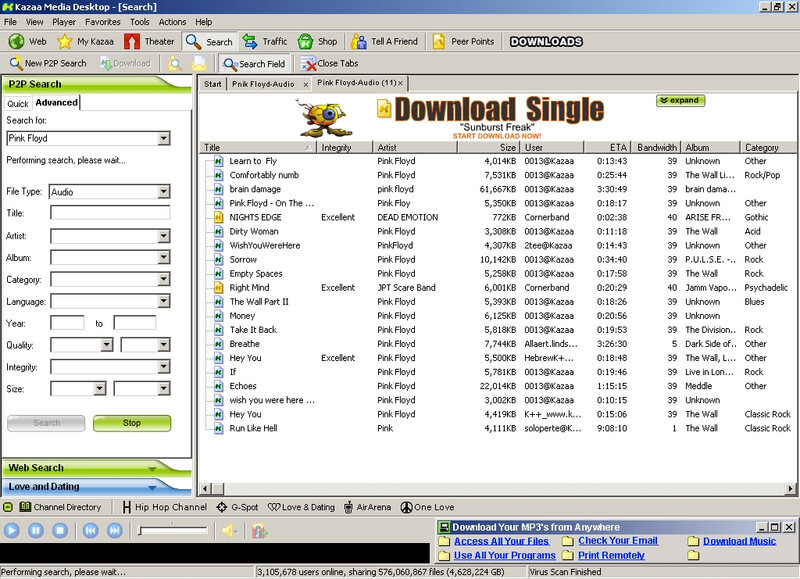

The site through time
Read the old front page here, in one piece, from our own capture: kazaa.com, 4 June 2002 →
Browse kazaa.com as it was, via the Internet Archive's Wayback Machine:
Ownership [edit]
Key figures [edit]
| Metric | Value | As of | Confidence |
|---|---|---|---|
| Downloads ▲ | 389 million | July 2006 | Estimated Cumulative client downloads widely cited around the settlement |
Confirmed official figures · Reported media, cites a source · Estimated analyst or our estimate
Why it shut down [edit]
Official line: Sharman Networks settled global piracy suits for over $100 million in July 2006 and converted Kazaa to a licensed music service, which faded away and quietly disappeared around 2012.
Our analysis: Kazaa inherited Napster's users and Napster's lawsuits. Its FastTrack network had no centre to unplug, so the industry sued the company across three continents until the 2006 settlement gutted it. The legal successor service never mattered; its founders had already used the same P2P stack to build Skype.
History [edit]
Heir to Napster
Kazaa launched in March 2001, built in Amsterdam by Niklas Zennström and Janus Friis with Estonian engineers on their FastTrack protocol: decentralised supernodes, no server to seize. When  Napster went dark that July, Kazaa caught its users, adding video and software sharing, and its installer's bundled adware became as famous as the downloads. Facing Dutch litigation, the founders sold the operation in 2002 to Sharman Networks, a company structured across Australia and Vanuatu specifically to be hard to sue.
Sued on three continents
It was sued anyway: by Dutch rights groups, by the RIAA and MPAA, and in Australia, where a 2005 federal court ruling found Sharman authorised infringement. In July 2006 Sharman settled globally for more than $100 million and promised a licensed Kazaa; the resulting subscription music service was ignored and quietly vanished around 2012. The real epilogue happened elsewhere: Zennström and Friis took FastTrack's peer-to-peer architecture and built Skype on it in 2003, turning the machinery of the piracy wars into a $8.5 billion telecom product.
Similar projects
 Megaupload
The file locker the FBI took down
2005–2012
Megaupload
The file locker the FBI took down
2005–2012
 LimeWire
Half your MP3s, half your malware
2000–2010
LimeWire
Half your MP3s, half your malware
2000–2010
 Napster
Every song in the world, free, right now
1999–2001
Napster
Every song in the world, free, right now
1999–2001
 Shareaza
The client whose own name was stolen
2002–2017
Shareaza
The client whose own name was stolen
2002–2017
 iMesh
Settled, went legal, outlived everyone, left without a word
1999–2016
iMesh
Settled, went legal, outlived everyone, left without a word
1999–2016
 Oink's Pink Palace
Raided by Interpol, and its founder walked free
2004–2007
Oink's Pink Palace
Raided by Interpol, and its founder walked free
2004–2007
Sources [edit]
- Kazaa settles $100m music lawsuit Al Jazeera 27 July 2006 [archived]
- Kazaa pays off the music publishers The Register 1 November 2006 [archived]
Last verified: 11 August 2026. Spotted an error? Suggest an edit (corrections with sources are reviewed and applied).