
LimeWire
Half your MP3s, half your malware
LimeWire was the Gnutella-based file-sharing client that carried P2P through the 2000s, launched in May 2000 by Mark Gorton's Lime Group. At its height it was installed on a large share of the world's PCs. A federal court found it liable for copyright infringement, and an injunction shut it down on 26 October 2010.
Timeline [edit]
- 2000
-
May 2000
Launch
LimeWire launches
Gnutella-based P2P client in Java.
- 2006
-
4 August 2006
Legal
RIAA sues Lime Group
Arista Records LLC v. Lime Group LLC.
- 2007
-
2007
Peak
The default P2P client worldwide
Tens of millions of monthly users after rivals collapse.
- 2008
-
2008
Peak
Found on more than a third of scanned PCs
Survey data makes LimeWire the most installed P2P client in the world.
- 2010
-
12 May 2010
Legal
Court finds LimeWire liable for inducing infringement
Judge Kimba Wood's summary judgment.
-
26 October 2010
Shutdown
Injunction disables LimeWire
The client's sharing functionality is switched off.
-
November 2010
Incident
The "Pirate Edition" appears
A resurrected community build forces Lime Group back to court to kill its own creation.
- 2011
-
12 May 2011
Legal
$105 million settlement with the labels
Ends the damages phase of the case.
- 2022
-
May 2022
Revival
Brand revived as an NFT marketplace
New owners unrelated to the original company relaunch the name; the P2P client stays dead.
How it looked [edit]
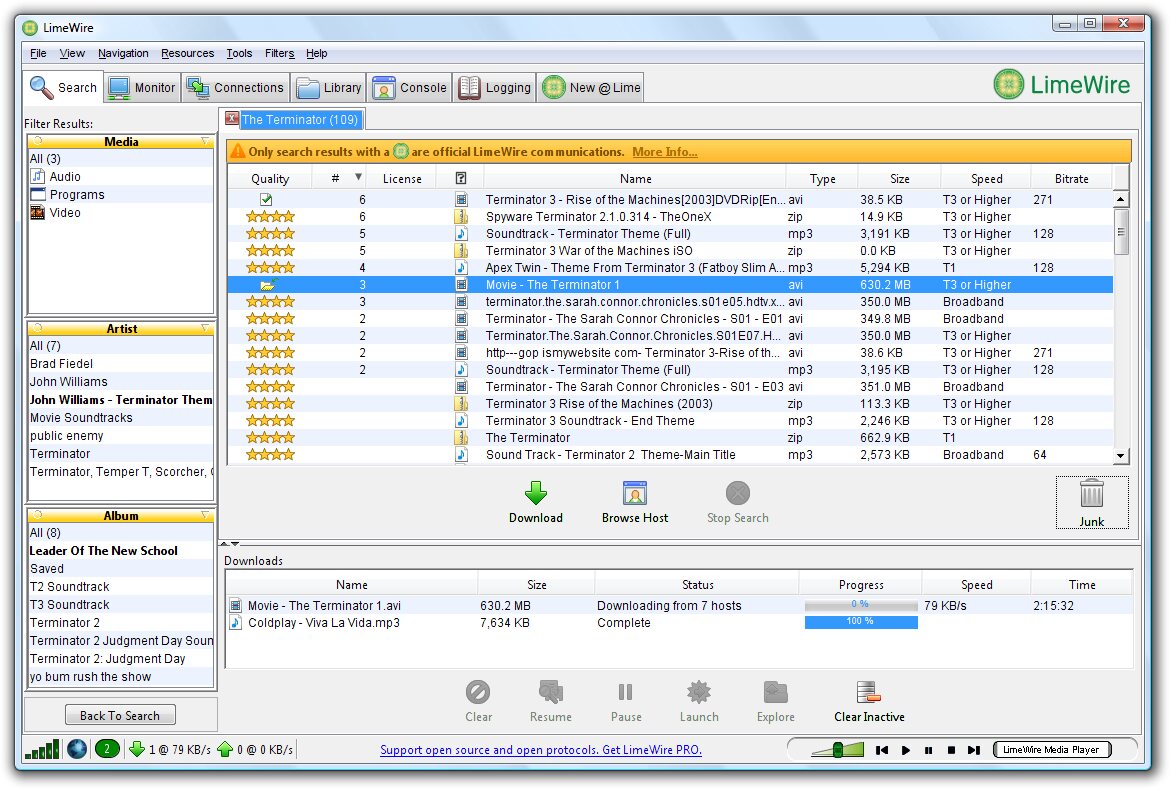

The site through time
Read the old front page here, in one piece, from our own capture: limewire.com, 3 June 2005 →
Browse limewire.com as it was, via the Internet Archive's Wayback Machine:
Ownership [edit]
Key figures [edit]
| Metric | Value | As of | Confidence |
|---|---|---|---|
| Monthly active users ▲ | 50 million | October 2010 | Reported Monthly users around the shutdown |
Confirmed official figures · Reported media, cites a source · Estimated analyst or our estimate
Why it shut down [edit]
Official line: A federal injunction ordered LimeWire to disable "the searching, downloading, uploading, file trading and/or file distribution functionality" of its software, which it did on 26 October 2010.
Our analysis: LimeWire was the last mass-market P2P client standing after Napster and Kazaa fell, and the RIAA's 2006 lawsuit ended the same way: a 2010 ruling found it liable for inducing infringement, the injunction switched it off, and a $105 million settlement followed.
History [edit]
The green lime
LimeWire launched in May 2000, a Java-based client on the decentralised Gnutella network: no central index, nothing to unplug. As  Napster died in court and
  Kazaa drowned in adware and lawsuits, LimeWire became the default way a generation filled its iPods, complete with the era's rites of passage: mislabeled tracks, 'Bill Clinton eats a hamburger' fakes, and the occasional payload of malware.
Arista v. Lime Group
The RIAA sued in August 2006, days after Kazaa's owners settled for over $100 million. In May 2010 Judge Kimba Wood found LimeWire and Gorton personally liable for inducing copyright infringement; on 26 October 2010 an injunction ordered the distribution features disabled, and the client greeted users with a legal notice instead of search results. Lime Group settled with the labels for $105 million in May 2011. The brand was resurrected in 2022 by unrelated owners as an NFT marketplace, a second life that has nothing to do with the software 50 million people ran every month.
The domain today
limewire.com was revived in 2022 by new owners as a file transfer and digital collectibles company. It uses the name and a version of the logo, but it is a different business run by different people, and nothing of the Gnutella client survives in it.
Similar projects
 Kazaa
The post-Napster free-for-all
2001–2012
Kazaa
The post-Napster free-for-all
2001–2012
 Megaupload
The file locker the FBI took down
2005–2012
Megaupload
The file locker the FBI took down
2005–2012
 Napster
Every song in the world, free, right now
1999–2001
Napster
Every song in the world, free, right now
1999–2001
 Shareaza
The client whose own name was stolen
2002–2017
Shareaza
The client whose own name was stolen
2002–2017
 iMesh
Settled, went legal, outlived everyone, left without a word
1999–2016
iMesh
Settled, went legal, outlived everyone, left without a word
1999–2016
 Oink's Pink Palace
Raided by Interpol, and its founder walked free
2004–2007
Oink's Pink Palace
Raided by Interpol, and its founder walked free
2004–2007
Sources [edit]
- Court Order Shuts Down LimeWire's File-Sharing Software NPR 27 October 2010 [archived]
- The History Of LimeWire: How It Worked And What Happened To It SlashGear 25 July 2023 [archived]
Last verified: 11 August 2026. Spotted an error? Suggest an edit (corrections with sources are reviewed and applied).