
BearShare
Paid the RIAA $30 million, then became someone else
BearShare was one of the big Gnutella clients, launched in December 2000 and known for cramming a media player, a library manager, IRC and a support forum into one window. After the Grokster ruling its owners settled with the RIAA for $30 million and sold everything to iMesh. What came back three months later wore the BearShare name but was a different program on a different network.
Timeline [edit]
- 2000
-
4 December 2000
Launch
BearShare is released
Free Peers ships a Gnutella client built around a media player and library manager.
- 2005
-
27 June 2005
Legal
The Grokster ruling lands
The community forums close abruptly while Free Peers negotiates with the RIAA.
- 2006
-
4 May 2006
Shutdown announced
$30 million settlement
Free Peers agrees to disband and to sell every BearShare asset to MusicLab.
-
17 August 2006
Rebrand
BearShare v6 arrives
A reskinned iMesh client on a different network, sold under the old name.
How it looked [edit]
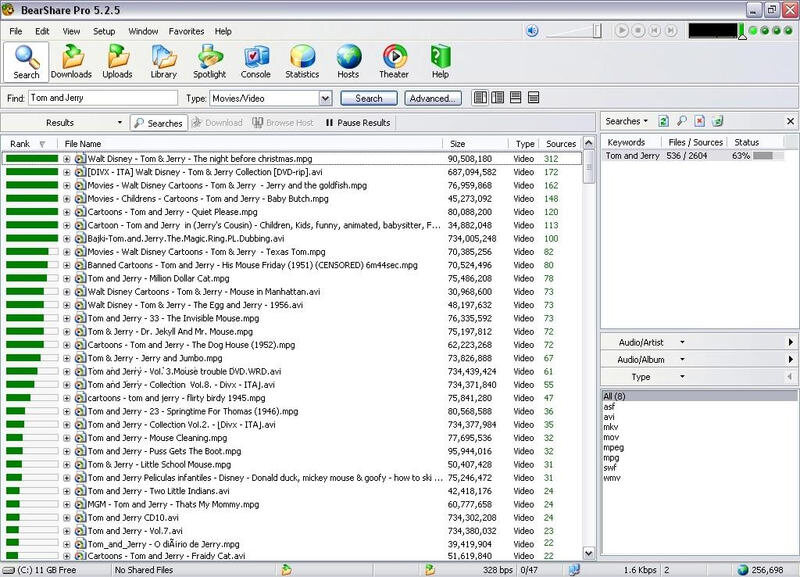
The site through time
Read the old front page here, in one piece, from our own capture: bearshare.com, 24 May 2003 →
Browse bearshare.com as it was, via the Internet Archive's Wayback Machine:
Ownership [edit]
Key figures [edit]
| Metric | Value | As of | Confidence |
|---|---|---|---|
| Downloads ▲ | 75 million | 2005 | Estimated Reported downloads of the Gnutella-era client |
Confirmed official figures · Reported media, cites a source · Estimated analyst or our estimate
Why it shut down [edit]
Official line: On 4 May 2006 Free Peers agreed to pay the RIAA $30 million and hand every BearShare asset to MusicLab, an iMesh subsidiary. On 17 August 2006 a reskinned iMesh client was released under the BearShare name.
Our analysis: BearShare is the clearest case of a brand outliving its product. Nothing of the Gnutella client survived the settlement except the name, the logo and the user list, all of which were sold to a competitor the record industry had already approved.
History [edit]
The everything client
Vincent Falco and Louis Tatta released BearShare on 4 December 2000 through their company Free Peers. It ran on Gnutella, and unlike the leaner clients it tried to be a whole environment: a media player, a library window for organising your collection, an IRC client, and help pages and support forums opened inside the application itself.
That ambition cut both ways. BearShare was also known, for years, for the adware that came with it, and for versions that behaved very differently depending on where you had downloaded them.
Settling first
The Supreme Court decided MGM v. Grokster on 27 June 2005. Within days the BearShare community forums closed without explanation while Free Peers negotiated with the RIAA. The moderators simply moved to a new site and carried on supporting the software from there.
On 4 May 2006 the settlement was announced. Free Peers would pay the RIAA $30 million, disband, promise never to run an unlicensed music service again, and transfer the BearShare technology, domain name and user data to MusicLab, a subsidiary of iMesh. BearShare was the first of the seven services the RIAA had targeted to settle. Two others, WinMX and iHub2, shut down rather than agree to anything.
A different program with the same name
On 17 August 2006 MusicLab released BearShare v6. It did not use Gnutella. It connected to iMesh's own network, sold DRM-locked music, screened uploads with acoustic fingerprinting, and blocked any video longer than fifteen minutes so that nobody could share a film.
Existing users who updated found a music shop where their file-sharing client had been. The original BearShare, the Gnutella one, had ended in May and nobody had told them.
The domain today
bearshare.com is now a music blog run by someone unconnected to Free Peers, MusicLab or iMesh. It is not a continuation of either BearShare, and nothing on it dates from before 2006.
Similar projects
 Kazaa
The post-Napster free-for-all
2001–2012
Kazaa
The post-Napster free-for-all
2001–2012
 LimeWire
Half your MP3s, half your malware
2000–2010
LimeWire
Half your MP3s, half your malware
2000–2010
 Megaupload
The file locker the FBI took down
2005–2012
Megaupload
The file locker the FBI took down
2005–2012
 Shareaza
The client whose own name was stolen
2002–2017
Shareaza
The client whose own name was stolen
2002–2017
 Napster
Every song in the world, free, right now
1999–2001
Napster
Every song in the world, free, right now
1999–2001
 iMesh
Settled, went legal, outlived everyone, left without a word
1999–2016
iMesh
Settled, went legal, outlived everyone, left without a word
1999–2016
Sources [edit]
- P2P BearShare Pays $30 Million To RIAA, Shuts Down InformationWeek 5 May 2006 [archived]
- BearShare Settles with RIAA for $30m BetaNews 5 May 2006 [archived]
Last verified: 13 August 2026. Spotted an error? Suggest an edit (corrections with sources are reviewed and applied).