
Boo.com
$135 million in eighteen months, on a site nobody could load
Boo.com sold fashion online from offices in five countries, with a 3D product viewer and an animated assistant called Miss Boo. It spent $135 million of venture capital in eighteen months, launched six months late onto a web that could not render it, and went into receivership six months after that. It became Europe's defining dot-com failure.
Timeline [edit]
- 1998
-
1998
Launch
Boo.com is founded
Three Swedish founders raise money on the strength of Bokus.com.
- 1999
-
October 1999
Peak
400 staff across six cities
London, Amsterdam, Munich, New York, Paris and Stockholm, before launch.
-
November 1999
Launch
The site finally opens
Six months late, with 3D product views most customers cannot load.
- 2000
-
18 May 2000
Shutdown
Receivership
$20 million was needed by midnight. Half arrived. Over 400 jobs go.
-
June 2000
Acquisition
Fashionmall.com buys the brand
The technology sells for a fraction of what it cost to build.
How it looked [edit]
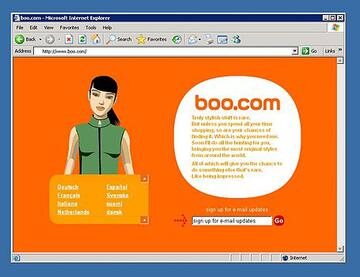
The site through time
Read the old front page here, in one piece, from our own capture: boo.com, 20 May 2000 →
Browse boo.com as it was, via the Internet Archive's Wayback Machine:
Ownership [edit]
Key figures [edit]
| Metric | Value | As of | Confidence |
|---|---|---|---|
| Valuation (USD) ▲ | 135 million | May 2000 | Confirmed Venture capital spent in roughly eighteen months |
Confirmed official figures · Reported media, cites a source · Estimated analyst or our estimate
Why it shut down [edit]
Official line: Placed into receivership on 18 May 2000 after failing to raise a further $20 million overnight. More than 400 staff and contractors lost their jobs and the company was liquidated.
Our analysis: Boo.com built a 3D shopping experience with a virtual assistant for an audience on dial-up modems. The site was so heavy that most of its target customers could not use it, and the company had spent the money to launch in eighteen countries before finding that out.
History [edit]
Ambition, in five cities at once
Ernst Malmsten, Kajsa Leander and Patrik Hedelin had already built Bokus.com into Europe's third largest online bookshop. That record made raising money for Boo.com straightforward. The plan was to sell branded sportswear and fashion to fashionable 18 to 24 year olds, in eighteen countries, in several languages and currencies, from day one.
They started with 40 people on Carnaby Street in London. By October 1999 there were 400, across offices in London, Amsterdam, Munich, New York, Paris and Stockholm, with a launch that had already slipped repeatedly.
A site built for a web that did not exist yet
What eventually launched in the autumn of 1999 was genuinely advanced: products rendered in 3D that you could rotate and zoom, an animated shop assistant named Miss Boo, and interface conventions that would not become normal for another decade.
It was also close to unusable. The pages required Flash and JavaScript in quantities that dial-up modems, which is what most customers had, could not deliver. Loading a single product could take minutes. Mac users could not use the site at all for months. The company had built for the bandwidth of 2010 and launched into 1999.
Eighteen months
The spending never slowed. Staff flew business class, offices were expensive, and marketing ran in every market simultaneously. Boo.com went through $135 million in about eighteen months.
On 18 May 2000 Malmsten told his board that unless $20 million arrived by midnight the company was finished. Roughly half was found. The company went into receivership that night, and more than 400 people lost their jobs. The technology sold for a fraction of its cost, and Fashionmall.com bought the brand in a fire sale two weeks later.
Malmsten wrote a book about it the following year, called Boo Hoo. It remains the most honest account anyone from that era published about themselves.
Similar projects
 Blockbuster
Turned down Netflix for $50 million, and one store survives
1985–2014
Blockbuster
Turned down Netflix for $50 million, and one store survives
1985–2014
 Webvan
Right idea, twenty years early, at a billion dollars a mistake
1999–2001
Webvan
Right idea, twenty years early, at a billion dollars a mistake
1999–2001
 Half.com
It once bought a whole town for its name
2000–2017
Half.com
It once bought a whole town for its name
2000–2017
 Jet.com
Walmart paid $3 billion, then switched it off
2015–2020
Jet.com
Walmart paid $3 billion, then switched it off
2015–2020
 eToys.com
Worth more than Toys R Us, for about a year
1997–2001
eToys.com
Worth more than Toys R Us, for about a year
1997–2001
 Redbox
A dollar a night from a vending machine, until the lights went out mid-rental
2002–2024
Redbox
A dollar a night from a vending machine, until the lights went out mid-rental
2002–2024
Sources [edit]
- Boo.com, Online Fashion Retailer, Goes Out of Business The New York Times 19 May 2000 [archived]
- Boo.com, five years on The Guardian 16 May 2005 [archived]
Last verified: 13 August 2026. Spotted an error? Suggest an edit (corrections with sources are reviewed and applied).