
Webvan
Right idea, twenty years early, at a billion dollars a mistake
Webvan delivered groceries to your door in a thirty minute window you chose yourself, in 1999. It raised nearly $400 million, ordered a billion dollars of automated warehouses, expanded into ten cities, and went bankrupt in three years. Almost everything it tried to do is now ordinary.
Timeline [edit]
- 1996
-
1996
Launch
Webvan is founded
Louis Borders sets out to build grocery delivery as an engineering problem.
- 1999
-
June 1999
Launch
Deliveries begin in the Bay Area
Thirty minute delivery windows, chosen by the customer.
-
5 November 1999
Funding
IPO closes 65% above the offer price
The market values a company with almost no revenue at billions.
- 2000
-
26 June 2000
Acquisition
HomeGrocer bought for $1.2 billion in stock
A loss-making rival absorbed to buy scale.
-
December 2000
Peak
Ten metropolitan areas
$178.5 million of sales against $525.4 million of costs.
- 2001
-
9 July 2001
Shutdown
Chapter 11 and shutdown
About 2,000 people lose their jobs. Amazon later buys the assets.
How it looked [edit]
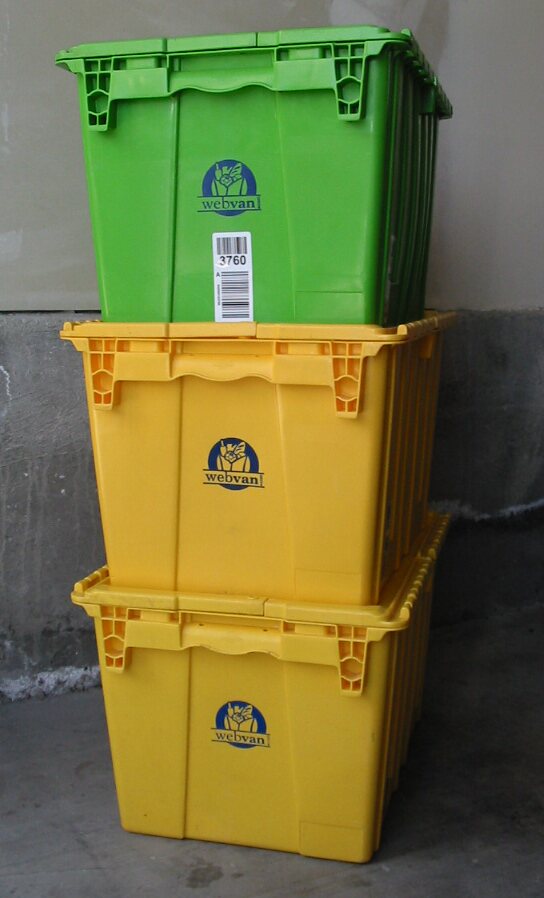

The site through time
Read the old front page here, in one piece, from our own capture: webvan.com, 28 May 2000 →
Browse webvan.com as it was, via the Internet Archive's Wayback Machine:
Ownership [edit]
Key figures [edit]
| Metric | Value | As of | Confidence |
|---|---|---|---|
| Revenue (USD) ▲ | 178.5 million | 2000 | Reported Peak annual sales, against $525.4 million of expenses |
Confirmed official figures · Reported media, cites a source · Estimated analyst or our estimate
Why it shut down [edit]
Official line: Filed for Chapter 11 bankruptcy on 9 July 2001 and shut the service down, having raised more than $396 million in venture funding and spent far more building infrastructure ahead of demand.
Our analysis: Webvan built for a scale it never reached. Investors pushed for first-mover advantage, so it ordered $1 billion of automated warehouses before it knew whether people would buy groceries online, and the fixed costs arrived long before the customers.
History [edit]
Building the future first
Louis Borders, who had co-founded the Borders bookshop chain in 1971, started Webvan in 1996. The idea was not a shop with delivery attached. It was a purpose-built system: automated distribution centres, a fleet of vans, routing software, and a promise that your groceries would arrive inside a thirty minute window that you picked.
Investors loved it and pushed hard for speed, because whoever got there first was supposed to own the category. Benchmark, Sequoia and Softbank put in hundreds of millions. Goldman Sachs' venture arm added $50 million, E-Trade and Yahoo $10 million each. In total more than $396 million of venture money went in before the IPO.
Webvan spent it. A $1 billion order went to Bechtel for warehouse construction. In 2000 it bought its loss-making competitor HomeGrocer for $1.2 billion in stock and expanded to ten metropolitan areas at once.
The numbers underneath
At its peak in 2000 Webvan booked $178.5 million in sales against $525.4 million in expenses. The warehouses were built for volumes that would have made the model work and were running at a fraction of them. Each new city multiplied the fixed cost before it multiplied the revenue.
Bankruptcy, and vindication
Webvan filed for Chapter 11 on 9 July 2001, shut down, and laid off about 2,000 people. It is one of the largest dot-com failures by capital destroyed.
The uncomfortable part is that it was right. Grocery delivery in narrow time windows, run out of dedicated dark stores, is now a normal business that several large companies compete in. Amazon bought Webvan's assets, hired some of its people, and used the warehouse designs. The idea survived. The company just paid for the experiment.
Similar projects
 Blockbuster
Turned down Netflix for $50 million, and one store survives
1985–2014
Blockbuster
Turned down Netflix for $50 million, and one store survives
1985–2014
 Half.com
It once bought a whole town for its name
2000–2017
Half.com
It once bought a whole town for its name
2000–2017
 Jet.com
Walmart paid $3 billion, then switched it off
2015–2020
Jet.com
Walmart paid $3 billion, then switched it off
2015–2020
 Boo.com
$135 million in eighteen months, on a site nobody could load
1999–2000
Boo.com
$135 million in eighteen months, on a site nobody could load
1999–2000
 eToys.com
Worth more than Toys R Us, for about a year
1997–2001
eToys.com
Worth more than Toys R Us, for about a year
1997–2001
 Redbox
A dollar a night from a vending machine, until the lights went out mid-rental
2002–2024
Redbox
A dollar a night from a vending machine, until the lights went out mid-rental
2002–2024
Sources [edit]
- Webvan delivers its last word: bankruptcy CNET 9 July 2001 [archived]
- Online grocer Webvan closes, will file for bankruptcy The Seattle Times (AP) 9 July 2001 [archived]
Last verified: 13 August 2026. Spotted an error? Suggest an edit (corrections with sources are reviewed and applied).