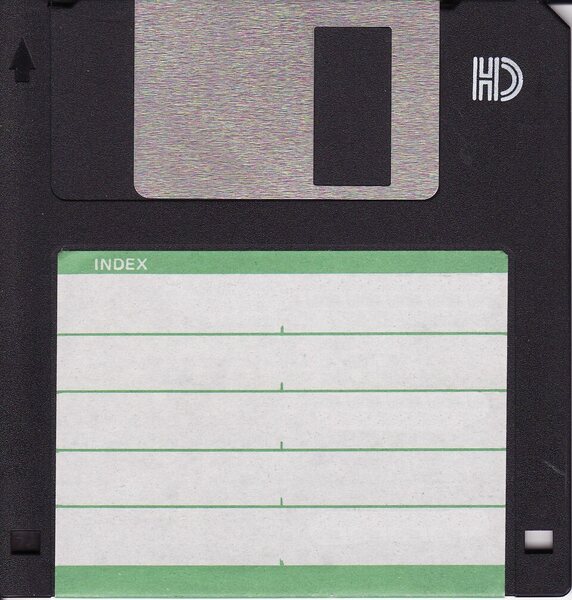
Floppy disk
Forty years of the disk everyone saved to, from the IBM 8-inch to the last 3.5-inch Sony boxes in 2011
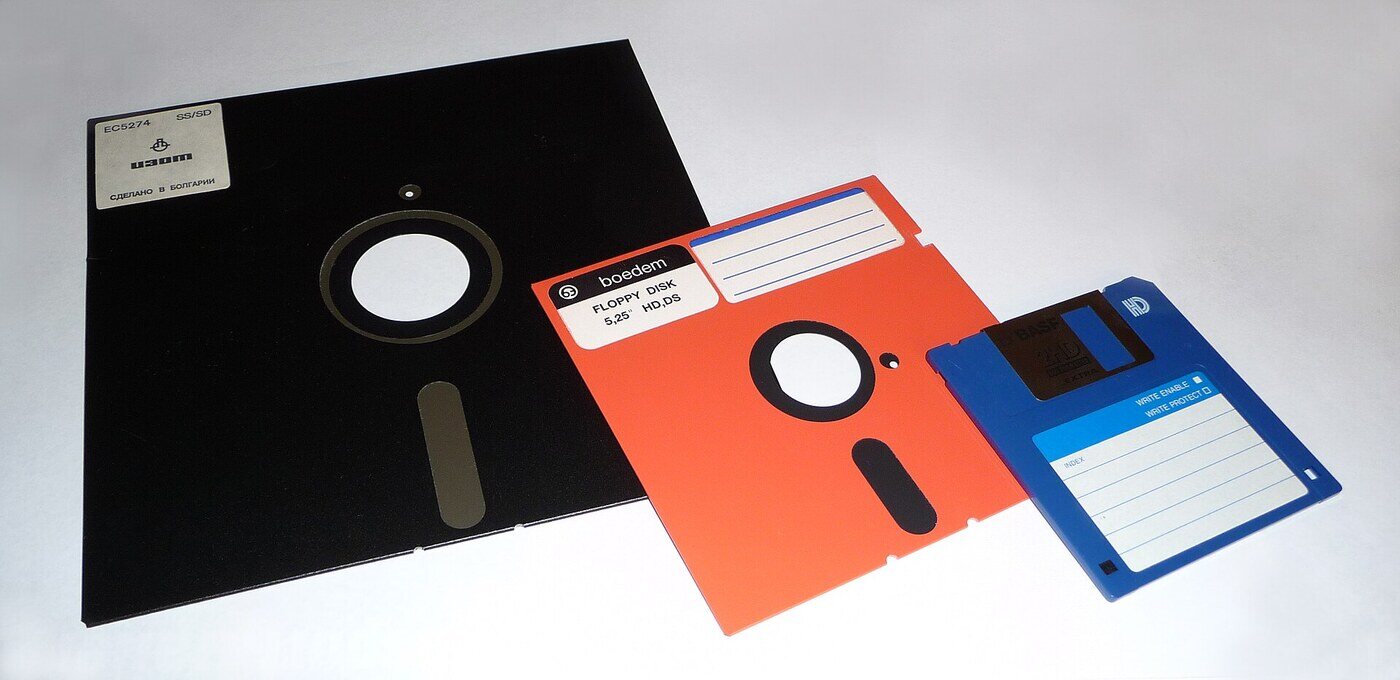
The floppy disk was the removable magnetic storage medium of personal computing: the 8-inch IBM disk of 1971, the 5.25-inch Shugart disk of 1976 and the 3.5-inch Sony disk of 1982 that became the universal 1.44 MB diskette of the PC and Mac era. It shipped in every computer for two decades, was dropped from the iMac in 1998 and from mainstream PCs in the early 2000s, and Sony, the last major manufacturer, ended sales in March 2011.
Timeline [edit]
- 1971
-
1971
Launch
IBM ships the 8-inch floppy
80 KB, read-only, for loading mainframe microcode.
- 1976
-
1976
Version
The 5.25-inch minifloppy
Shugart Associates; adopted by the Apple II and IBM PC.
- 1982
-
1982
Version
Sony introduces the 3.5-inch disk
Rigid shell and metal shutter; the Macintosh adopts it in 1984.
- 1987
-
1987
Version
1.44 MB high density
The disk everyone means by "floppy".
- 1998
-
15 August 1998
Decline
The iMac ships without a floppy drive
Apple is mocked; everyone follows within five years.
- 2003
-
February 2003
Decline
Dell drops the drive as standard
"R.I.P. Floppy Disk", says the BBC.
- 2010
-
23 April 2010
Shutdown announced
Sony to end floppy sales
The last major maker gives a March 2011 date.
- 2011
-
March 2011
Shutdown
Sony stops selling floppies in Japan
The end of mass production.
- 2024
-
3 July 2024
other
Japan removes the floppy from government procedures
The digital minister declares his war on the floppy won.
How it looked [edit]
Ownership [edit]
Why it shut down [edit]
Official line: Sony, which by 2010 sold about 70% of the 3.5-inch floppies still being made, announced on 23 April 2010 that it would stop selling them in Japan in March 2011, having already left most other markets. The disk had been dying for a decade: Apple dropped the drive with the iMac in August 1998, Dell stopped fitting it as standard in 2003, and by then a floppy held less than one photo from a phone. USB sticks, CD-R and the network took over.
Our analysis: The floppy disk lasted longer than any storage medium of the personal computer era because everything read it and it was cheap. It died when its capacity, 1.44 MB, stopped being a rounding error and started being a joke, and when the drive was the only moving part left in a PC that anyone wanted to remove. It has the strangest afterlife of any dead technology: it is the save icon in a billion pieces of software, it was still updating Boeing 747 software in 2020, and Japan only finished removing it from government forms in 2024.
History [edit]
Three sizes
IBM built the first floppy disk, an 8-inch, 80 KB read-only disk in a fabric-lined sleeve, to load microcode into System/370 mainframes; it shipped in 1971 and the team, led by David Noble under Alan Shugart, added a read-write version in 1973. Shugart left IBM, and his Shugart Associates introduced the 5.25-inch minifloppy in 1976 for the microcomputers then appearing; it went into the Apple II and the IBM PC and by the early 1980s held 360 KB, later 1.2 MB. Sony introduced the 3.5-inch disk in a rigid plastic shell with a sliding metal shutter in 1982; the Macintosh adopted it in 1984, IBM in 1986, and the 1.44 MB high-density version of 1987 became the disk everyone means by "floppy".
For twenty years it was how software was sold, how work went home and how files moved between machines. Windows 95 came on 13 disks. The Zip drive, LS-120 and others tried to replace it with a bigger disk and could not dislodge it, because a floppy drive was in every computer and cost almost nothing.
Removed, then unmade
Apple shipped the iMac in August 1998 without a floppy drive and was mocked for it for about a year. Dell stopped fitting drives as standard in early 2003, the BBC ran the headline "R.I.P. Floppy Disk", and PC World, the UK retailer, stopped selling the disks in 2007. USB flash drives, writable CDs and email had taken every job the floppy had.
Manufacturing outlasted demand. On 23 April 2010 Sony, which still made most of the world's 3.5-inch disks and had sold 12 million of them in Japan in 2009, said it would end sales in March 2011. That was the last major line. Since then the remaining stock has been traded by a handful of dealers, most famously floppydisk.com in California, whose owner told The Register in 2022 he had about four years of supply left, and the disks kept turning up in odd places: Boeing 747 navigation databases updated by floppy in 2020, US nuclear command systems until 2019, and Japanese government procedures until July 2024, when the digital minister declared victory in his war on the floppy.
The domain today
There is no domain; the disk lives on as the save icon.
Similar projects
 MiniDisc
Sony's recordable disc for the Walkman age, outlived by the iPod and its own fans
1992–2025
MiniDisc
Sony's recordable disc for the Walkman age, outlived by the iPod and its own fans
1992–2025
 Iomega Zip drive
100 megabytes on a fat floppy, and the Click of Death
1995–2003
Iomega Zip drive
100 megabytes on a fat floppy, and the Click of Death
1995–2003
 HD DVD
Toshiba's high-definition disc, first to market and dead within two years
2006–2008
HD DVD
Toshiba's high-definition disc, first to market and dead within two years
2006–2008
 Windows Media Center
The living-room PC that arrived before streaming
2002–2015
Windows Media Center
The living-room PC that arrived before streaming
2002–2015
 GameSpy
The middleware that ran multiplayer, then took it away
1996–2014
GameSpy
The middleware that ran multiplayer, then took it away
1996–2014
 Adobe Flash
The plugin that animated the web
1996–2020
Adobe Flash
The plugin that animated the web
1996–2020
Sources [edit]
- R.I.P. Floppy Disk BBC News 1 April 2003 [archived]
- Sony announces the death of the floppy disk Wired 26 April 2010 [archived]
- Boeing 747s still get critical updates via floppy disks The Verge 11 August 2020 [archived]
- Last floppy disk business has about four years of life left The Register 20 September 2022 [archived]
- Japan declares victory in effort to end government use of floppy disks Reuters 3 July 2024 [archived]
- The evolution of the floppy disk for PCs The New York Times 14 March 1990 [archived]
Last verified: 16 August 2026. Spotted an error? Suggest an edit (corrections with sources are reviewed and applied).