
Iomega Zip drive
100 megabytes on a fat floppy, and the Click of Death
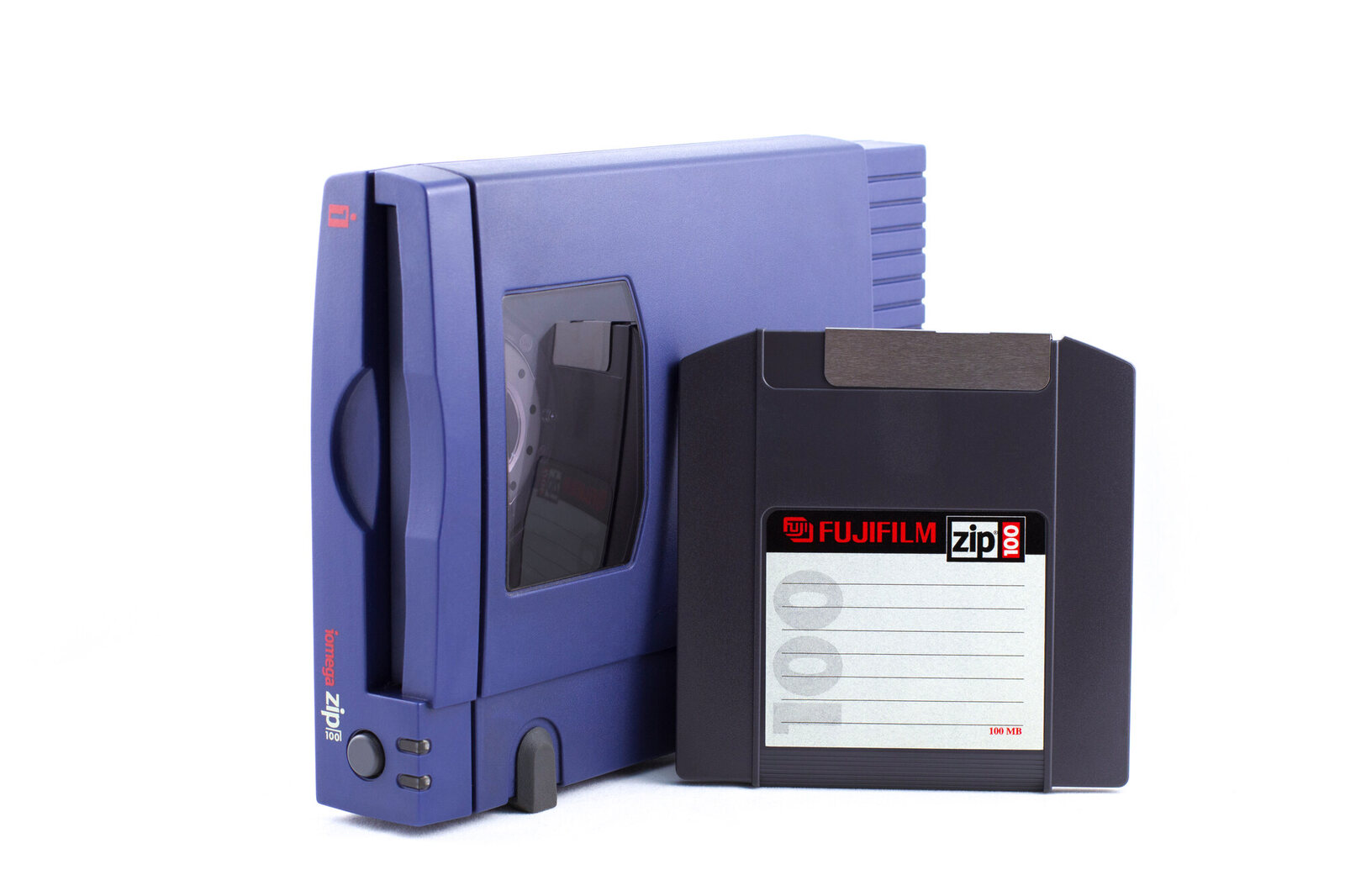
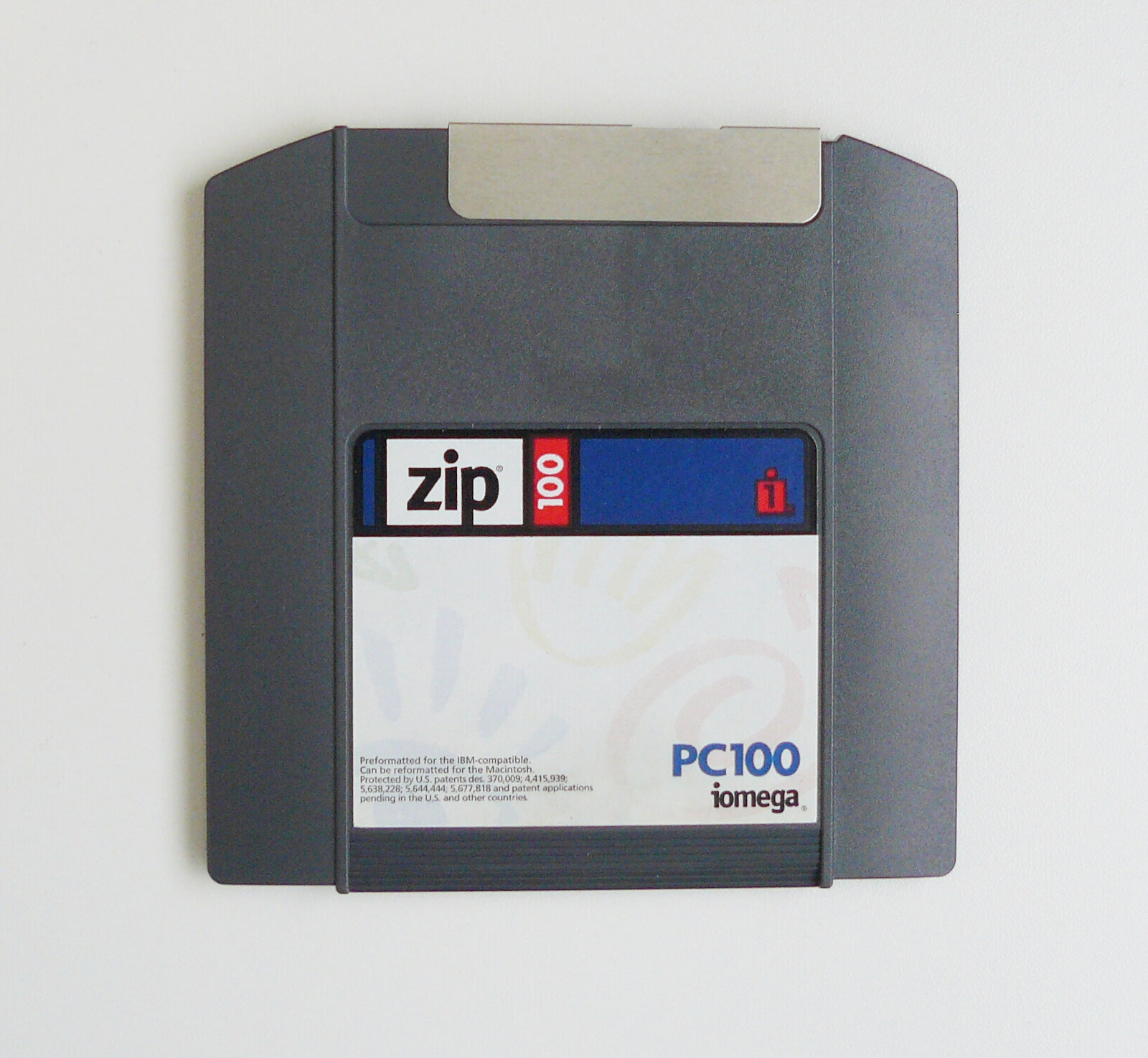
The Zip drive was Iomega's removable disk system, launched in 1995: a $199 drive and $20 cartridges holding 100 MB, seventy times a floppy, later 250 MB and 750 MB. It sold in the tens of millions, shipped built into Macs and PCs, and became notorious for the "Click of Death" drive failure and the 1998 class action that followed. Recordable CDs and USB flash drives made it redundant, and it faded away in the early 2000s.
Timeline [edit]
- 1995
-
March 1995
Launch
The Zip drive ships
$199 for the drive, 100 MB cartridges for about $20.
- 1997
-
1997
Peak
Millions of drives
Built into Power Macs and PCs; Iomega stock becomes a mania.
- 1998
-
1998
Version
Zip 250
A 250 MB drive that reads the old cartridges.
-
September 1998
Legal
The Click of Death class action
Iomega is sued over drives that destroy their own disks; it settles in 2001.
- 2000
-
2000
Decline
CD-R and USB flash
Cheaper, bigger, and standard on every PC.
- 2002
-
2002
Version
Zip 750
The last capacity bump, to a market that has moved on.
- 2003
-
2003
Shutdown
The Zip drive fades out
PC makers drop it; Iomega moves to hard disks and network storage.
- 2008
-
9 June 2008
Acquisition
EMC buys Iomega
$213 million; the name later disappears into Lenovo.
How it looked [edit]
The site through time
Read the old front page here, in one piece, from our own capture: iomega.com, 24 June 1998 →
Browse iomega.com as it was, via the Internet Archive's Wayback Machine:
Ownership [edit]
Why it shut down [edit]
Official line: Recordable CDs, then USB flash drives and cheap hard disks, made a $10 100 MB cartridge pointless within a few years of its 1998 peak; the "Click of Death" failures and a class action over them wrecked the drive's reputation in the meantime. Iomega's Zip business shrank through the early 2000s and the drives were dropped from new PCs; Iomega itself was bought by EMC in 2008 and the name later folded into Lenovo.
Our analysis: The Zip drive solved a real problem for about three years: the floppy held 1.4 MB, files had grown past it, and Iomega's cartridge was the sneakernet of the graphic design and university world. Then the CD-R fell to a dollar a disc, then a USB stick fit on a keyring, and a proprietary drive that clicked itself to death had no answer. Its slot as the ubiquitous removable disk lasted exactly as long as the gap it filled.
History [edit]
Seventy floppies
Iomega, a Utah company that had sold the bulky Bernoulli Box removable disk since the early 1980s, launched the Zip drive in early 1995 at $199 with 100 MB cartridges for about $20 each. It plugged into a parallel port or SCSI, was small and blue, and held about seventy floppy disks' worth of data at a time when a floppy could no longer hold a Photoshop file. Designers, students, small offices and anyone moving files between machines bought it in enormous numbers; Iomega shipped millions of drives within two years, the stock became one of the manias of the mid-1990s, and Apple built the drive into Power Macs.
Iomega followed with a 250 MB version in 1998, the Jaz drive for gigabyte cartridges, and eventually a 750 MB Zip in 2002. For a few years "put it on a Zip" was as ordinary a phrase as "burn it to a CD" would be.
The Click of Death
The drives had a fault. Misaligned heads could strike a cartridge with an audible click, ruin the disk, and, worse, damage the next drive the disk was put into. Users named it the Click of Death, a Sunday newspaper column made it famous, and in September 1998 a class action accused Iomega of concealing the defect. Iomega settled in 2001 with rebates. The episode became one of the enduring stories of 1990s computing, and it hit just as the product's window was closing.
Overtaken
Recordable CD drives fell below $200 and blank discs to under a dollar by 1999, holding 650 MB each; USB flash drives arrived in 2000 and hard disks kept getting cheaper. Zip sales peaked in the late 1990s and slid every year after. PC makers dropped the built-in drives, Iomega ended volume production of the standard cartridges in the early 2000s and moved into external hard disks and network storage. EMC bought the company in 2008 for $213 million, and the Iomega name disappeared into Lenovo's LenovoEMC joint venture in 2013.
The domain today
iomega.com now redirects to Lenovo. Working Zip drives and boxes of cartridges are common in second-hand shops, and the click, when it comes, still means what it always meant.
Similar projects
 MiniDisc
Sony's recordable disc for the Walkman age, outlived by the iPod and its own fans
1992–2025
MiniDisc
Sony's recordable disc for the Walkman age, outlived by the iPod and its own fans
1992–2025
 Floppy disk
Forty years of the disk everyone saved to, from the IBM 8-inch to the last 3.5-inch Sony boxes in 2011
1971–2011
Floppy disk
Forty years of the disk everyone saved to, from the IBM 8-inch to the last 3.5-inch Sony boxes in 2011
1971–2011
 HD DVD
Toshiba's high-definition disc, first to market and dead within two years
2006–2008
HD DVD
Toshiba's high-definition disc, first to market and dead within two years
2006–2008
 GameSpy
The middleware that ran multiplayer, then took it away
1996–2014
GameSpy
The middleware that ran multiplayer, then took it away
1996–2014
 Windows Media Center
The living-room PC that arrived before streaming
2002–2015
Windows Media Center
The living-room PC that arrived before streaming
2002–2015
 Adobe Flash
The plugin that animated the web
1996–2020
Adobe Flash
The plugin that animated the web
1996–2020
Sources [edit]
- Iomega sued over Zip-zapping "click of death" The Register 11 November 1998 [archived]
- Iomega's Zip disk: the Click of Death's lasting legacy Tedium 6 December 2016 [archived]
- From Zip to nought: the rise and fall of Iomega Hackaday 24 March 2026 [archived]
Last verified: 15 August 2026. Spotted an error? Suggest an edit (corrections with sources are reviewed and applied).