MiniDisc
Sony's recordable disc for the Walkman age, outlived by the iPod and its own fans
MiniDisc was Sony's magneto-optical recordable disc format, launched in November 1992 as a digital successor to the cassette: a 64 mm disc in a hard shell holding 74 minutes of ATRAC-compressed audio you could record, title and rearrange. It became a mainstream format in Japan and a cult one elsewhere, added long-play, NetMD and Hi-MD, and lost to CD-R and the iPod. Sony shipped its last players in March 2013 and made its last blank discs in February 2025.
Timeline [edit]
- 1992
-
November 1992
Launch
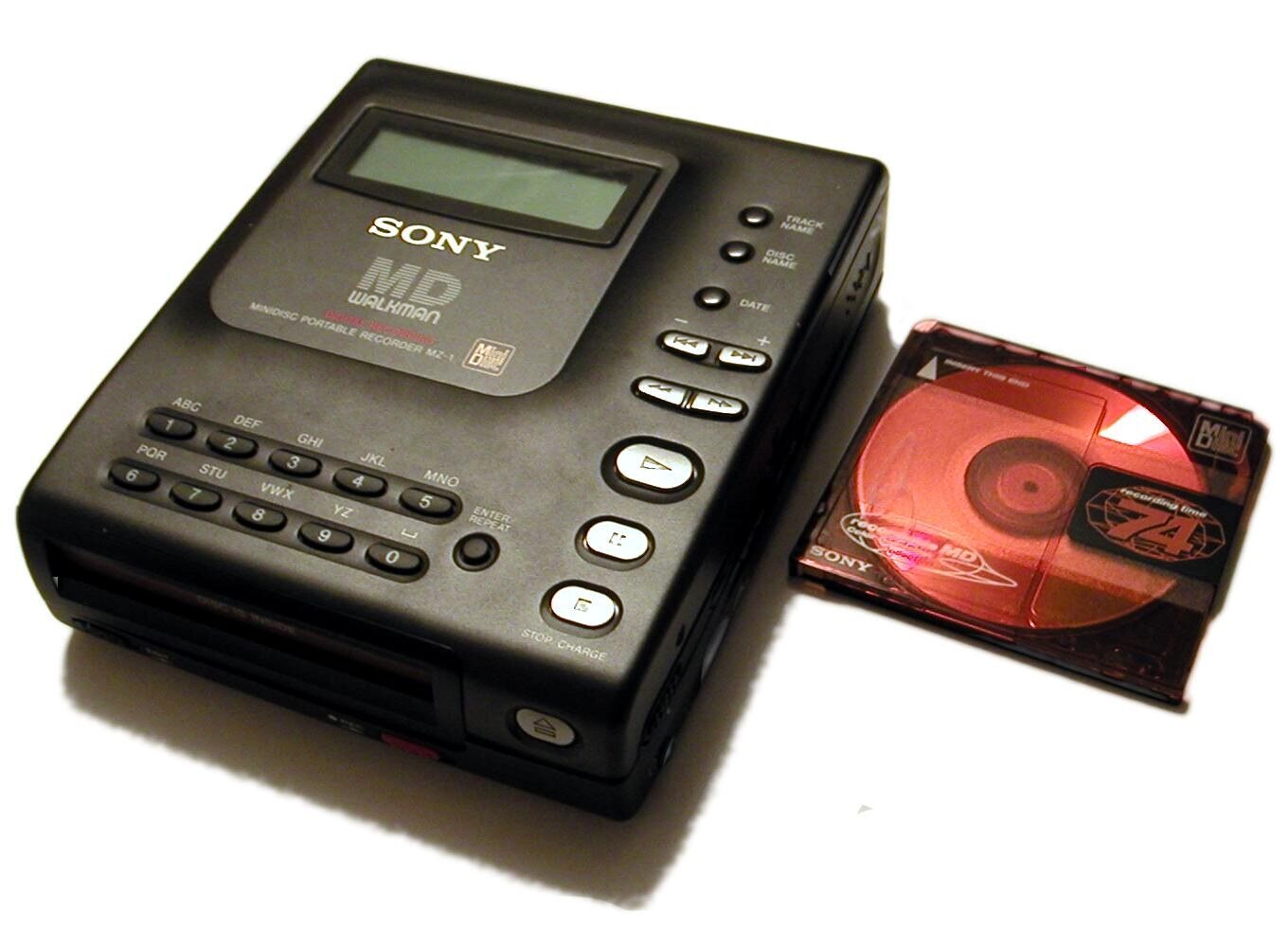
MiniDisc launches with the Sony MZ-1
A recordable digital disc for the Walkman age, in the same season as Philips' DCC.
- 1996
-
1996
Peak
Mainstream in Japan
MD Walkmans and dual-deck stereos are everywhere; the US market stays with cassettes.
- 2000
-
2000
Version
MDLP
Long-play mode quadruples the running time.
- 2001
-
2001
Version
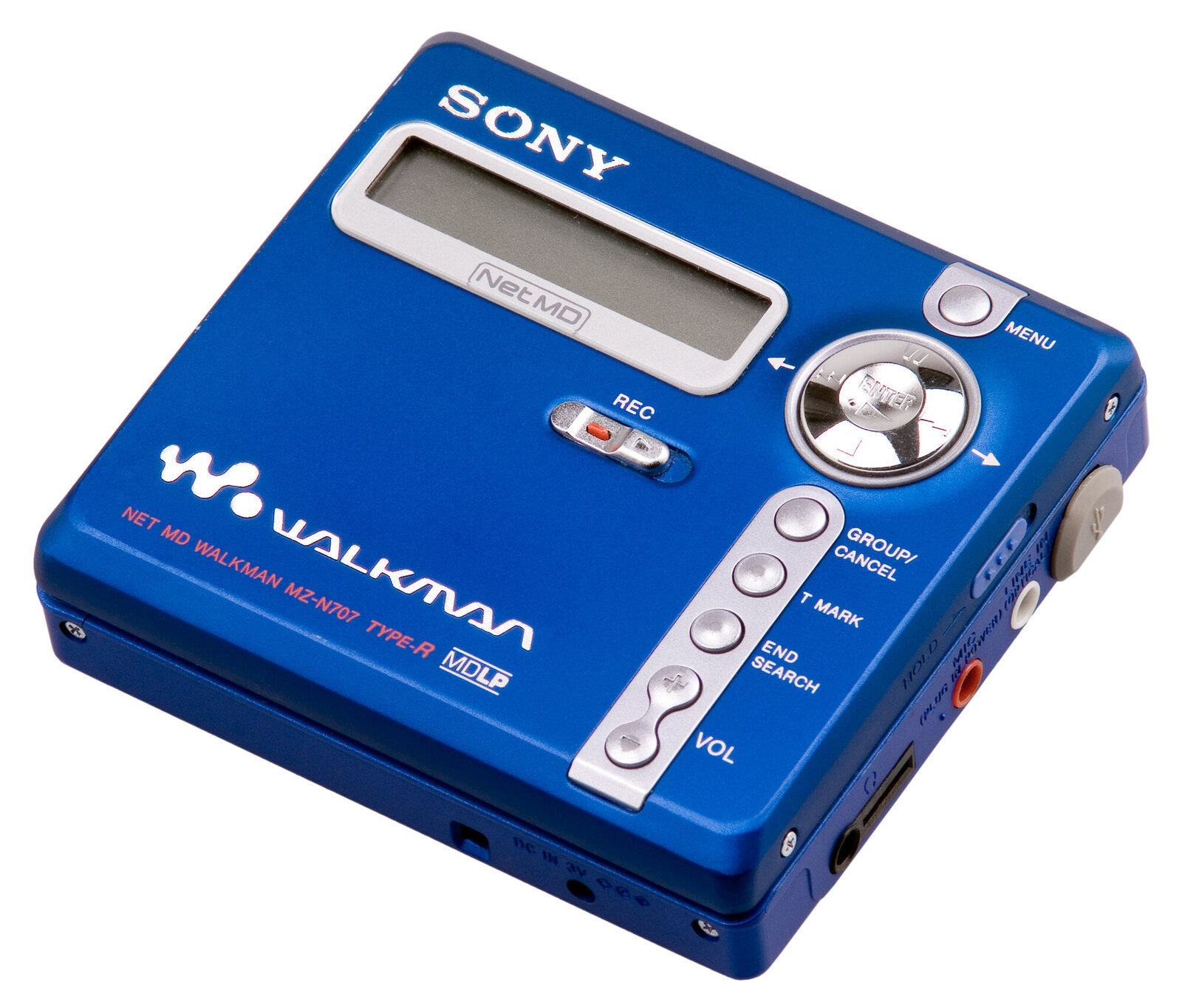
NetMD
Load a disc from a PC over USB, through SonicStage.
-
October 2001
Decline
The iPod arrives
Hard-disk and then flash players make carrying discs obsolete.
- 2004
-
2004
Version
Hi-MD
1 GB discs and MP3 playback; the last major revision.
- 2013
-
1 February 2013
Shutdown announced
Sony announces the end of its players
The last MiniDisc Walkmans ship in March 2013.
- 2025
-
23 January 2025
Shutdown announced
Sony announces the end of the discs
Recordable MiniDisc, MD Data and MiniDV production stops in February 2025.
-
February 2025
Shutdown
The last blank MiniDiscs are made
No successor. The format is left to its collectors.
How it looked [edit]
The site through time
Browse sony.jp as it was, via the Internet Archive's Wayback Machine:
Ownership [edit]
Why it shut down [edit]
Official line: MiniDisc never displaced the cassette in the United States and was overtaken everywhere by CD-R in the late 1990s and by hard-disk and flash players after the iPod in 2001. Sony announced on 1 February 2013 that it would ship its last MiniDisc players that March, and on 24 January 2025 that production of recordable MiniDisc media, the last it made, would end in February 2025 with no successor.
Our analysis: MiniDisc was the best portable recording format ever sold: small, editable, near-CD quality, almost indestructible. It arrived when Americans were happy with cassettes, cost too much for too long, and by the time it was cheap the MP3 player had made the whole idea of carrying discs obsolete. It won Japan and parts of Europe and Asia and lost the market that mattered, then lingered for a decade in radio studios and among people who liked pressing a real button.
History [edit]
A disc you could record
Sony launched MiniDisc in November 1992 with the MZ-1 recorder, a couple of months after Philips launched the rival Digital Compact Cassette. The disc was a 64 mm magneto-optical platter in a plastic caddy holding 74 minutes of audio compressed with Sony's ATRAC codec, and it did things no cassette could: instant track skipping, on-disc titles, splitting and moving tracks, and re-recording a million times without wear. A memory buffer meant it did not skip when jogged. It was, in short, the CD you could record, five years before recordable CD drives were affordable.
In Japan it took off, helped by dual-deck stereos and a market that recorded from CD rentals; MD Walkmans were everywhere in Tokyo by the late 1990s. In Europe it found a real if smaller audience. In the United States it never quite happened: the players were expensive, pre-recorded MiniDisc albums flopped, and the cassette held on until the CD-R took over.
MDLP, NetMD, Hi-MD
Sony kept improving it. MDLP in 2000 quadrupled the running time; NetMD in 2001 let you load a disc from a PC over USB, through Sony's widely disliked SonicStage software; Hi-MD in 2004 offered 1 GB discs and native MP3 playback. Each was a good answer to a question the market had stopped asking. Apple's iPod arrived in October 2001 and by 2004 flash and hard-disk players had made carrying discs, however small, look quaint. MiniDisc's last stronghold was professional and radio use, where the recorders were rugged and the discs cheap.
Two endings
Sony announced on 1 February 2013 that it would ship its last MiniDisc Walkman players in March 2013, twenty years after the first. Other makers had already left, and Sony's own component decks went soon after. The discs themselves stayed in production at Sony's plant in Tagajo for another twelve years, for the recorders still in use, until Sony said on 23 January 2025 that recordable MiniDisc, MD Data and MiniDV production would end in February 2025 with no successor. The last blank MiniDiscs went into collectors' drawers within weeks.
Afterlife
MiniDisc has had the retro revival that cassettes and vinyl had: working recorders sell for more than they did new, a small community writes new software to load discs from modern PCs, and independent labels release albums on MD in editions of a few hundred. It is one of the few formats whose users are, in 2026, more enthusiastic than they were in 1996.
The domain today
sony.jp is Sony's. The MiniDisc product pages are gone; the January 2025 notice ending media production is the last official word.
Similar projects
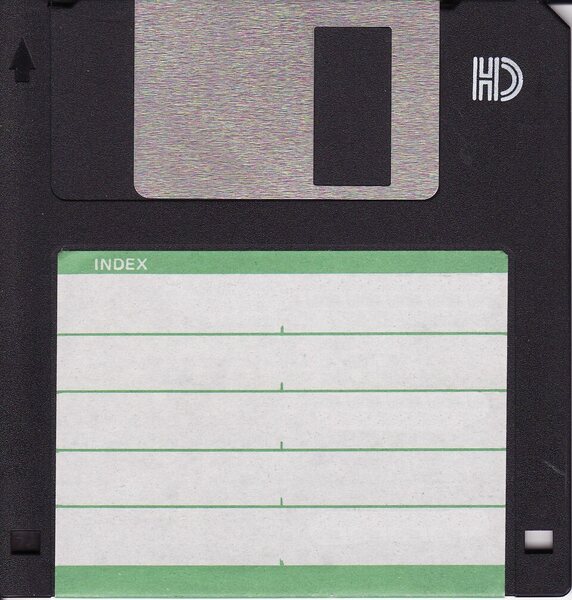 Floppy disk
Forty years of the disk everyone saved to, from the IBM 8-inch to the last 3.5-inch Sony boxes in 2011
1971–2011
Floppy disk
Forty years of the disk everyone saved to, from the IBM 8-inch to the last 3.5-inch Sony boxes in 2011
1971–2011
 Iomega Zip drive
100 megabytes on a fat floppy, and the Click of Death
1995–2003
Iomega Zip drive
100 megabytes on a fat floppy, and the Click of Death
1995–2003
 HD DVD
Toshiba's high-definition disc, first to market and dead within two years
2006–2008
HD DVD
Toshiba's high-definition disc, first to market and dead within two years
2006–2008
 GameSpy
The middleware that ran multiplayer, then took it away
1996–2014
GameSpy
The middleware that ran multiplayer, then took it away
1996–2014
 Windows Media Center
The living-room PC that arrived before streaming
2002–2015
Windows Media Center
The living-room PC that arrived before streaming
2002–2015
 Adobe Flash
The plugin that animated the web
1996–2020
Adobe Flash
The plugin that animated the web
1996–2020
Sources [edit]
- MiniDisc, the forgotten format The Guardian 24 September 2012 [archived]
- Sony says sayonara to MiniDisc, will sell its last players in March Engadget 1 February 2013 [archived]
- Sony bids farewell to the MiniDisc CNET 3 February 2013 [archived]
- Sony is halting production of recordable Blu-ray, MiniDiscs and MiniDV cassettes Engadget 24 January 2025 [archived]
Last verified: 15 August 2026. Spotted an error? Suggest an edit (corrections with sources are reviewed and applied).