
Grokster
The case that made building the tool a crime
Grokster was a FastTrack client from a company registered in Nevis, indistinguishable in practice from Kazaa. It matters far beyond what it did, because MGM v. Grokster established that distributing a tool with the object of promoting copyright infringement makes you liable for the infringement. The ruling ended Grokster and then, one by one, most of its competitors.
Timeline [edit]
- 2001
-
2001
Launch
Grokster launches
A FastTrack client aimed squarely at users leaving Napster.
- 2003
-
25 April 2003
Legal
Grokster wins in the district court
The court applies the Sony Betamax principle: a tool with lawful uses is lawful.
- 2004
-
19 August 2004
Legal
The Ninth Circuit affirms
Grokster wins again on appeal, and the studios go to the Supreme Court.
- 2005
-
27 June 2005
Legal
The Supreme Court rules 9 to 0 against Grokster
Distributing a tool with the object of promoting infringement makes you liable for it.
-
7 November 2005
Shutdown
Grokster settles and closes
$50 million, and the site is replaced by a notice telling visitors the service was illegal.
How it looked [edit]
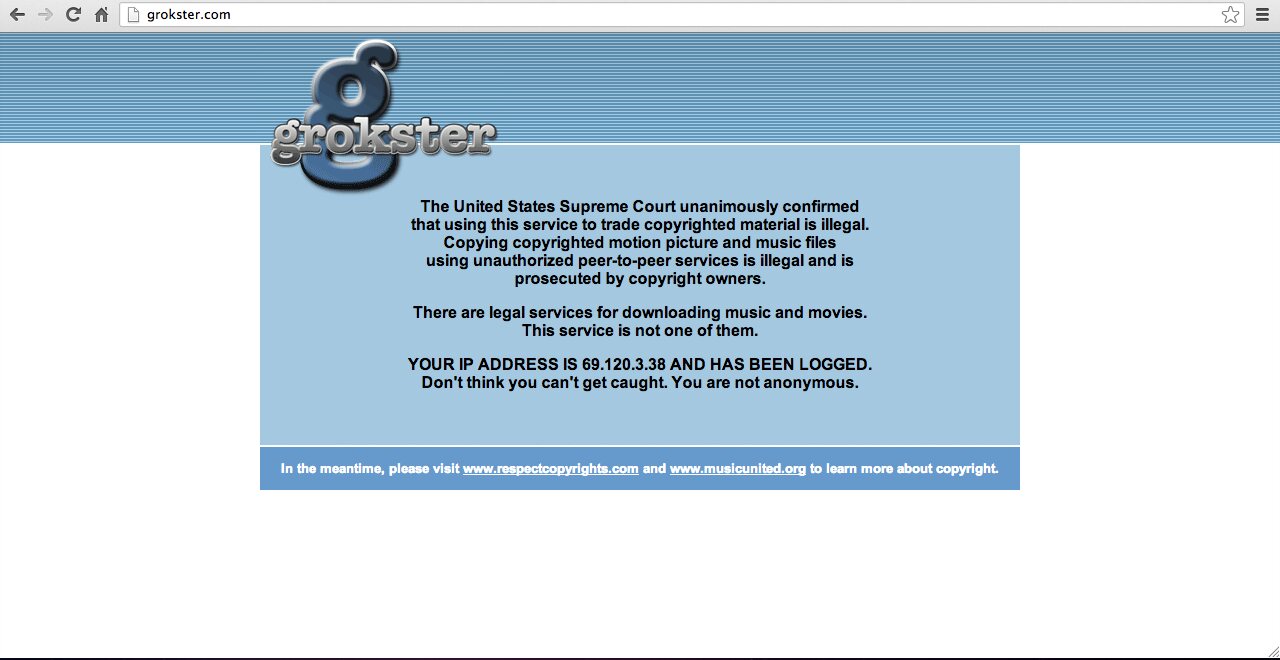
The site through time
Read the old front page here, in one piece, from our own capture: grokster.com, 1 June 2003 →
Browse grokster.com as it was, via the Internet Archive's Wayback Machine:
Ownership [edit]
Key figures [edit]
| Metric | Value | As of | Confidence |
|---|---|---|---|
| Downloads ▲ | 50 million | 2005 | Estimated Reported downloads of the Grokster client before the ruling |
Confirmed official figures · Reported media, cites a source · Estimated analyst or our estimate
Why it shut down [edit]
Official line: MGM Studios, Inc. v. Grokster, Ltd. was decided unanimously against Grokster on 27 June 2005. The company settled in November, paid $50 million and shut down, replacing its site with a warning notice.
Our analysis: Grokster had won twice in the lower courts on the Sony Betamax principle: a tool with legitimate uses is not illegal. The Supreme Court sidestepped that entirely and asked a different question, whether the company had encouraged infringement, which it plainly had.
History [edit]
An ordinary client
Grokster was not innovative. It ran on FastTrack, the same protocol behind Kazaa, and looked and behaved much like it. The company behind it was registered in Nevis in the West Indies, which was itself part of the design: the second generation of file-sharing companies had learned from Napster that owning the servers was what got you killed, so they owned as little as possible.
That was the legal theory. Files moved directly between users. Nothing passed through Grokster's machines. Under Sony Corp. v. Universal, the 1984 case that legalised the video recorder, a product with substantial non-infringing uses cannot be banned because some people misuse it. Grokster won on that argument in the district court, and won again in the Ninth Circuit.
The unanimous reversal
On 27 June 2005 the Supreme Court reversed, 9 to 0. It did not overrule Sony. It went around it, holding that "one who distributes a device with the object of promoting its use to infringe copyright, as shown by clear expression or other affirmative steps taken to foster infringement, is liable for the resulting acts of infringement by third parties."
The evidence on that point was not close. Grokster had advertised itself to former Napster users and had built no filtering at all. Intent, not architecture, became the test.
The notice
Grokster settled on 7 November 2005, agreeing to pay $50 million and to stop. Its website was replaced with a plain statement that there are legal services for downloading music and movies, that this service was not one of them, and that using it to share copyrighted works was illegal.
Within eighteen months the same reasoning had reached eDonkey, BearShare, WinMX, Kazaa and Morpheus. The second generation of file sharing did not lose an argument about technology. It lost one about marketing.
Similar projects
 Kazaa
The post-Napster free-for-all
2001–2012
Kazaa
The post-Napster free-for-all
2001–2012
 LimeWire
Half your MP3s, half your malware
2000–2010
LimeWire
Half your MP3s, half your malware
2000–2010
 Megaupload
The file locker the FBI took down
2005–2012
Megaupload
The file locker the FBI took down
2005–2012
 Shareaza
The client whose own name was stolen
2002–2017
Shareaza
The client whose own name was stolen
2002–2017
 Napster
Every song in the world, free, right now
1999–2001
Napster
Every song in the world, free, right now
1999–2001
 iMesh
Settled, went legal, outlived everyone, left without a word
1999–2016
iMesh
Settled, went legal, outlived everyone, left without a word
1999–2016
Sources [edit]
- MGM Studios, Inc. v. Grokster, Ltd., 545 U.S. 913 (2005) U.S. Supreme Court via Justia 27 June 2005 [archived]
- MGM Studios, Inc. v. Grokster, Ltd. Oyez 27 June 2005 [archived]
- Grokster agrees to shut down for good NBC News (AP) 7 November 2005
Last verified: 13 August 2026. Spotted an error? Suggest an edit (corrections with sources are reviewed and applied).