
Google Jamboard
Google's $5,000 whiteboard, retired to make room for Figma and Miro
Google Jamboard was a 55-inch 4K touchscreen whiteboard for G Suite, announced in October 2016 and shipping from May 2017 at $4,999, with a companion Jamboard app for phones, tablets and the web. It found a home mostly in classrooms. Google announced its end in September 2023, stopped supporting the hardware in September 2024 and shut the app down on 31 December 2024, pointing users to FigJam, Lucidspark and Miro.
Timeline [edit]
- 2016
-
25 October 2016
Launch
Jamboard is announced
A 55-inch 4K whiteboard for G Suite, Google's answer to the Surface Hub.
- 2017
-
23 May 2017
Launch
Jamboard goes on sale
$4,999 plus $600 a year, United States first.
-
23 May 2017
Feature
The Jamboard app
A free companion app for Android and iOS; the web version follows.
- 2020
-
April 2020
Peak
Remote schooling
The app is suddenly in classrooms everywhere, alongside the tools that will replace it.
- 2023
-
28 September 2023
Shutdown announced
Google announces the wind-down
Whiteboarding is handed to FigJam, Lucidspark and Miro.
- 2024
-
30 September 2024
Decline
Hardware support ends
The Jamboard devices lose software updates and support.
-
1 October 2024
Decline
The app goes read-only
No new jams; export before the end of the year.
-
31 December 2024
Shutdown
Jamboard shuts down
The app closes and unexported jams are deleted.
How it looked [edit]
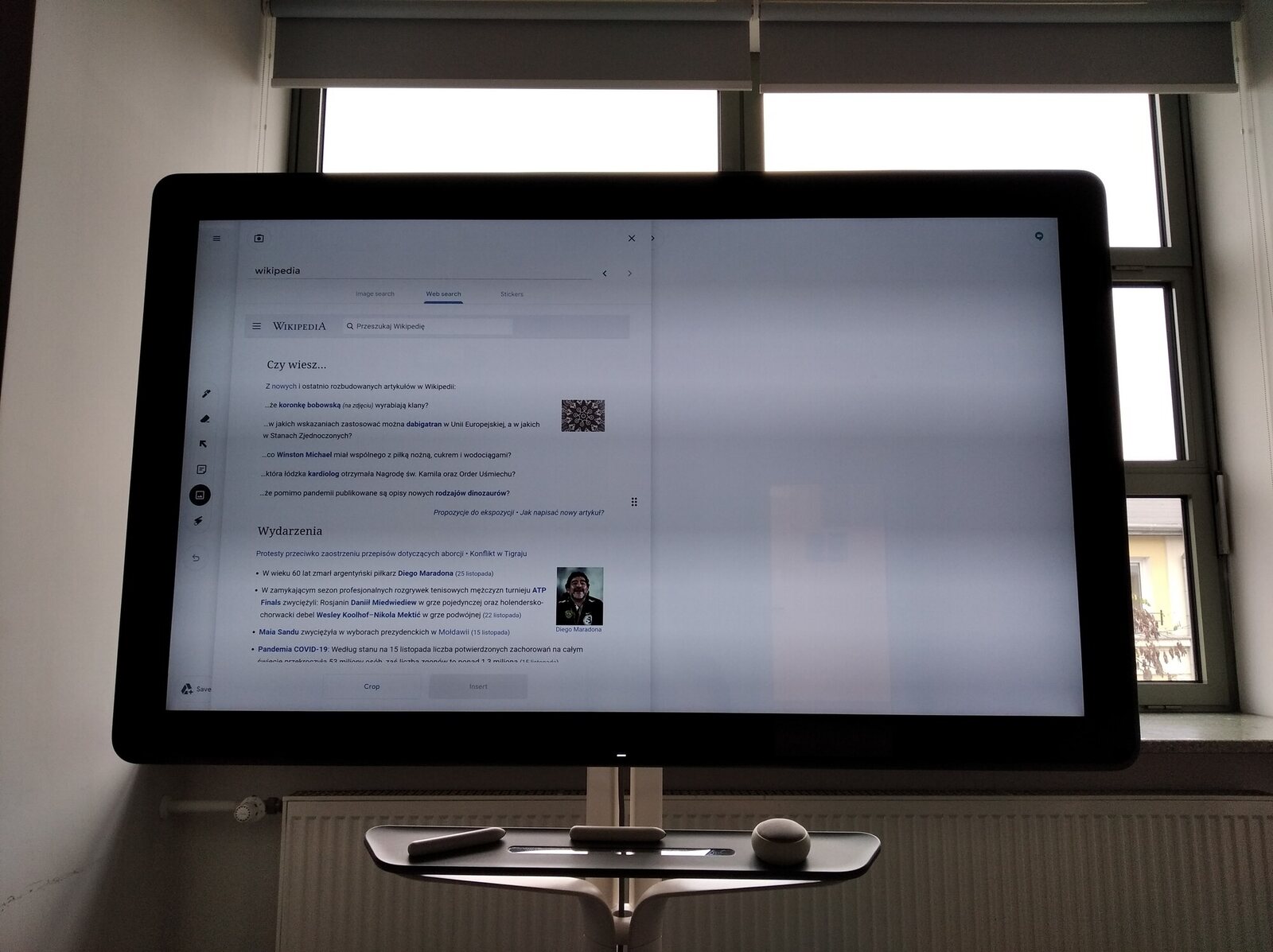
The site through time
Browse jamboard.google.com as it was, via the Internet Archive's Wayback Machine:
Ownership [edit]
Why it shut down [edit]
Official line: On 28 September 2023 Google announced it would wind down Jamboard, saying it would focus on Docs, Sheets and Slides and hand whiteboarding to partners FigJam, Lucidspark and Miro. Software support for the Jamboard hardware ended on 30 September 2024, the app became read-only on 1 October 2024, and on 31 December 2024 the app was shut down and remaining Jam files were deleted.
Our analysis: Jamboard was a well-made whiteboard for a world that turned out not to want to buy whiteboards from Google. The 55-inch screen cost about $5,000 plus a yearly fee, sold mostly to schools, and the free app that came with it was thin next to Miro or FigJam once every meeting moved online in 2020. Google chose to license and integrate rather than compete, and gave a rare 15 months' notice.
History [edit]
A whiteboard from Google
Google unveiled Jamboard on 25 October 2016 as its answer to Microsoft's Surface Hub: a 55-inch 4K touchscreen on a rolling stand, with a passive stylus and eraser that needed no batteries, a camera and speakers for Hangouts, and a "jam" that lived in Google Drive so people in other offices could draw on the same board from their phone or a second Jamboard. It went on sale in the United States on 23 May 2017 at $4,999 plus a $600 annual management fee, with the rolling stand extra.
The companion Jamboard app arrived the same year for Android and iOS, and later as a web app, free for anyone with a Google account. That app, rather than the hardware, is what most people meant by "Jamboard": a simple shared canvas with sticky notes, pens and Google image search, popular in schools that had standardised on Chromebooks and Google Classroom.
Meetings move online
The pandemic should have been Jamboard's moment, and in a sense it was: the app was suddenly in every remote classroom. But it was also the moment purpose-built collaboration tools like Miro, FigJam and Lucidspark pulled far ahead, with infinite canvases, templates and integrations, while Jamboard stayed a whiteboard with sticky notes and a cap on frames per jam. The expensive hardware sold to a niche, and Google, which had spent the same years integrating Miro and Figma into Meet and Workspace, had less and less reason to maintain its own.
Fifteen months' notice
On 28 September 2023 Google announced it would wind down Jamboard to "focus on core content collaboration across Docs, Sheets, and Slides" and rely on its partners for whiteboarding. Unusually for a Google shutdown, the timetable was long and clear: hardware software support ended on 30 September 2024, the app went read-only on 1 October 2024, and on 31 December 2024 the app was shut down and any Jam files not exported were deleted. Google published migration paths to FigJam, Lucidspark and Miro, and offered to convert jams to PDF.
The domain today
jamboard.google.com redirects to a Google support page titled "Jamboard device end of life information". The boards themselves, several thousand dollars of touchscreen each, still turn on and still cannot open a jam.
Similar projects
 Pebble
The smartwatch Kickstarter built, and Fitbit buried
2013–2018
Pebble
The smartwatch Kickstarter built, and Fitbit buried
2013–2018
 iPod
1,000 songs in your pocket
2001–2022
iPod
1,000 songs in your pocket
2001–2022
 Zune
Microsoft's answer to the iPod, five years late
2006–2015
Zune
Microsoft's answer to the iPod, five years late
2006–2015
 Humane AI Pin
The $699 phone killer that HP switched off ten months in
2024–2025
Humane AI Pin
The $699 phone killer that HP switched off ten months in
2024–2025
 Amazon Dash Button
A $4.99 button that ordered detergent, launched on the eve of April Fools' Day
2015–2019
Amazon Dash Button
A $4.99 button that ordered detergent, launched on the eve of April Fools' Day
2015–2019
 Project Ara
Google's modular phone, demoed for three years and never sold
2013–2016
Project Ara
Google's modular phone, demoed for three years and never sold
2013–2016
Sources [edit]
- Google's answer to Microsoft's Surface Hub is an equally giant digital whiteboard The Verge 25 October 2016 [archived]
- Jamboard, the whiteboard, reimagined for collaboration in the cloud Google 25 October 2016 [archived]
- The next phase of digital whiteboarding for Google Workspace Google Workspace Updates 28 September 2023 [archived]
- Google shutting down Jamboard, offering transition to other whiteboard apps 9to5Google 28 September 2023 [archived]
- Jamboard device end of life information Google 31 December 2024 [archived]
Last verified: 15 August 2026. Spotted an error? Suggest an edit (corrections with sources are reviewed and applied).