NCSA Mosaic
Put the pictures in the page, and the web took off
Mosaic was not the first web browser, but it was the first to put images inline with the text instead of opening them in a separate window, and the first that ordinary people could install and use. Released from a university lab in 1993, it made the web visible. Four years later it was finished, beaten by Netscape, which its own authors had left to build.
Timeline [edit]
- 1992
-
December 1992
Launch
Development begins at NCSA
Marc Andreessen and Eric Bina start work at the University of Illinois.
- 1993
-
23 January 1993
Launch
Mosaic is released
The first browser to show images inline with the text.
- 1994
-
4 April 1994
Decline
Andreessen leaves to found Netscape
He takes much of the team with him.
-
October 1994
Peak
On the cover of Wired
Mosaic is the face of the web going mainstream.
-
December 1994
Legal
Microsoft licenses Spyglass Mosaic
It becomes Internet Explorer. Both sides of the browser war start here.
- 1997
-
7 January 1997
Shutdown
NCSA ends development and support
Almost all users had already moved to Netscape.
How it looked [edit]

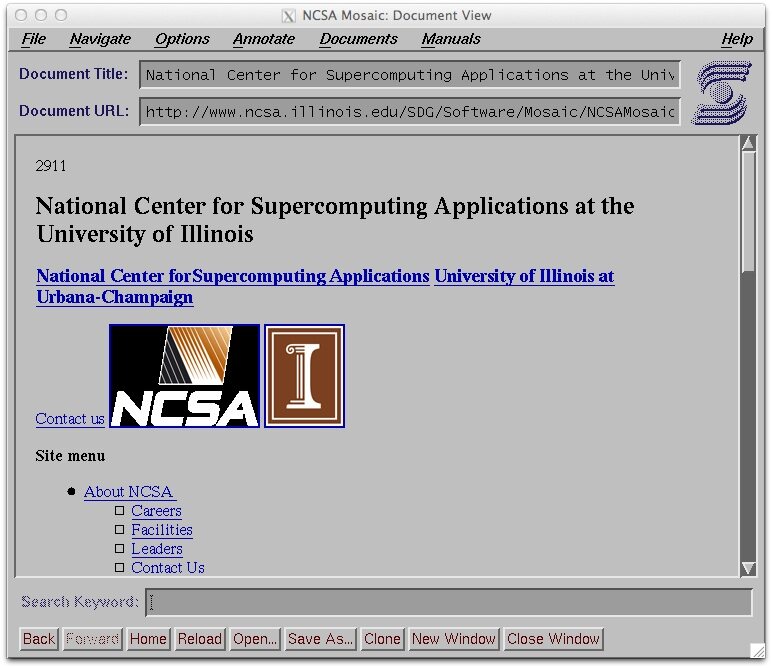
The site through time
Read the old front page here, in one piece, from our own capture: ncsa.illinois.edu, 20 December 1996 →
Browse ncsa.illinois.edu as it was, via the Internet Archive's Wayback Machine:
Ownership [edit]
Why it shut down [edit]
Official line: Development and support at the National Center for Supercomputing Applications ended in January 1997. Mosaic had already lost almost all of its users to Netscape Navigator, which was built by the people who had written Mosaic.
Our analysis: Mosaic was a research project that accidentally started an industry, and it was beaten by its own authors. Marc Andreessen left to found Netscape, took the approach with him, and shipped faster than a university lab could.
History [edit]
Images, in the page
Development began at the National Center for Supercomputing Applications, at the University of Illinois, in December 1992, and the first release came in January 1993. Marc Andreessen and Eric Bina wrote it.
Browsers already existed. WorldWideWeb, Erwise and ViolaWWW came first. What Mosaic did was make the web look like something rather than a document: it displayed images inline with the text instead of opening them in a separate window, it ran on ordinary personal computers, it installed without expertise, and it supported HTTP, FTP, NNTP and Gopher so it was useful from the first day.
That combination is why the web, rather than Gopher or anything else, became the thing everyone meant by "the internet". Wired put it on the cover in October 1994.
Beaten by its own authors
Andreessen left for California, co-founded what became Netscape, and hired much of the Mosaic team. Netscape Navigator shipped in late 1994 and took the market within months, because a funded company iterating weekly beats a university lab.
The lineage kept going in a second direction too. Spyglass licensed the Mosaic name and technology from the university, Microsoft licensed Spyglass Mosaic in December 1994, and that became Internet Explorer. Both sides of the first browser war descend from the same lab.
Retired
NCSA maintained Mosaic until 7 January 1997, by which point it had a tiny fraction of its users left, and then stopped.
Four years is short. In them, the web went from a physics document system to something with a front page.
Similar projects
 Internet Explorer
The browser that won the war and lost the peace
1995–2022
Internet Explorer
The browser that won the war and lost the peace
1995–2022
 Netscape Navigator
The browser that opened the web
1994–2008
Netscape Navigator
The browser that opened the web
1994–2008
 Microsoft Edge Legacy
Microsoft's fresh start that lasted one engine
2015–2021
Microsoft Edge Legacy
Microsoft's fresh start that lasted one engine
2015–2021
 Flock
The social web browser: Firefox, then Chromium, with Facebook and Twitter in the sidebar, bought by Zynga and closed in 2011
2005–2011
Flock
The social web browser: Firefox, then Chromium, with Facebook and Twitter in the sidebar, bought by Zynga and closed in 2011
2005–2011
 AOL Explorer
AOL's own tabbed browser on top of Internet Explorer, released in 2005, folded into OpenRide and AOL Desktop within two years
2005–2007
AOL Explorer
AOL's own tabbed browser on top of Internet Explorer, released in 2005, folded into OpenRide and AOL Desktop within two years
2005–2007
 ICQ
The messenger that gave you a number
1996–2024
ICQ
The messenger that gave you a number
1996–2024
Sources [edit]
- The (Second Phase of the) Revolution Has Begun Wired 1 October 1994 [archived]
- NCSA Mosaic National Center for Supercomputing Applications [archived]
- Mosaic Web Browser History - NCSA, Marc Andreessen, Eric Bina Living Internet
Last verified: 13 August 2026. Spotted an error? Suggest an edit (corrections with sources are reviewed and applied).