
AOL Explorer
AOL's own tabbed browser on top of Internet Explorer, released in 2005, folded into OpenRide and AOL Desktop within two years
AOL Explorer, first called AOL Browser, was a free web browser for Windows released by AOL on 19 July 2005, built on Internet Explorer's Trident engine and offering tabbed browsing with thumbnail previews, an RSS reader, a pop-up blocker and spyware alerts. Version 1.5 in May 2006 was the last; it was absorbed into AOL OpenRide in October 2006 and AOL Desktop in December 2007.
Timeline [edit]
- 2003
-
29 May 2003
other
Microsoft settles with AOL
$750 million and a seven-year IE licence.
- 2005
-
19 July 2005
Launch
AOL Explorer released
Tabs, thumbnails, feeds and a side panel on top of IE.
- 2006
-
11 May 2006
Version
AOL Explorer 1.5
Widgets, themes and a feeds screensaver; the last version.
-
4 October 2006
pivot
AOL OpenRide ships
The browser becomes one pane of four.
- 2007
-
December 2007
Shutdown
AOL Desktop replaces OpenRide
The standalone browser is no longer offered.
How it looked [edit]
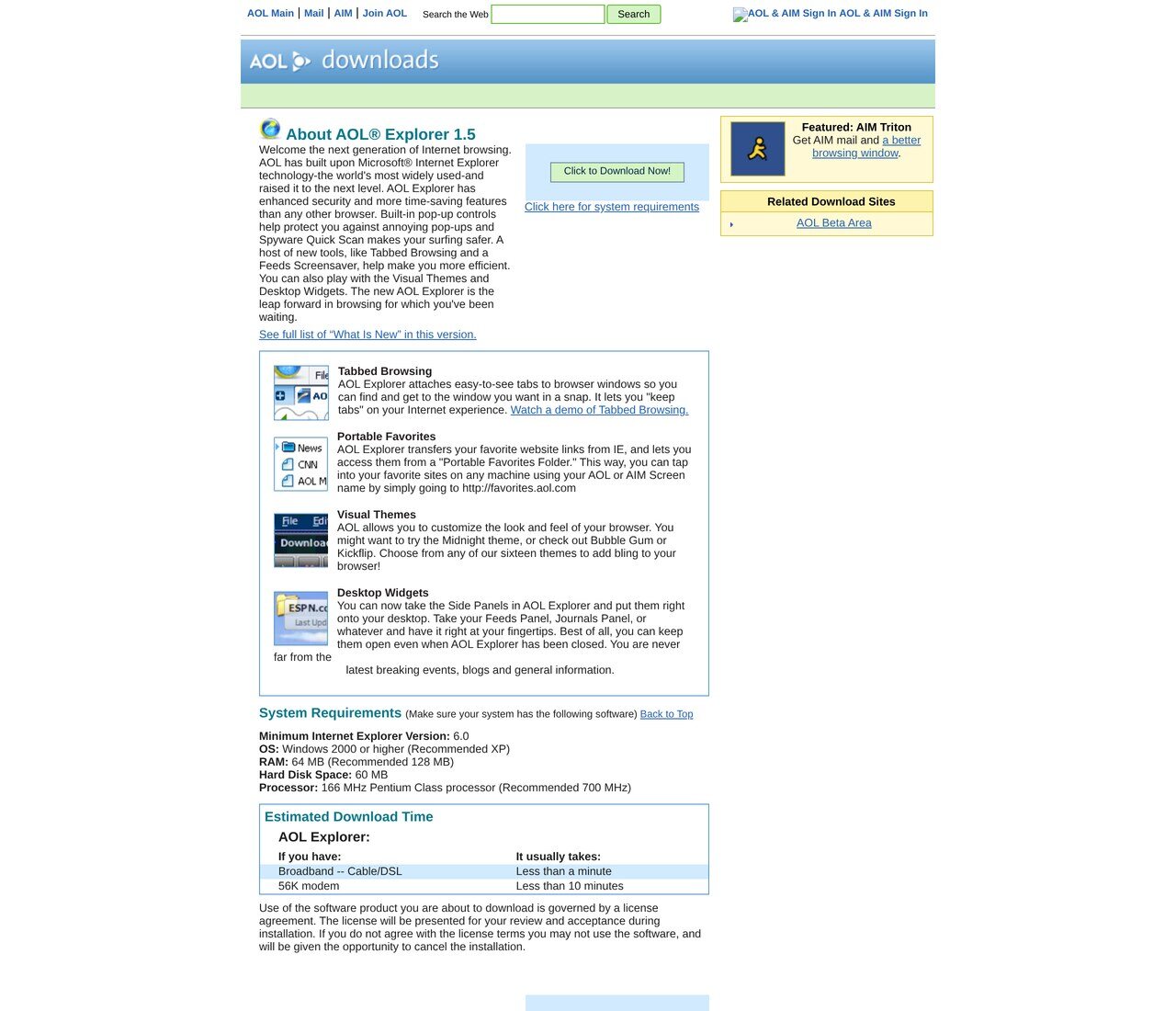
The site through time
Browse downloads.channel.aol.com/browser as it was, via the Internet Archive's Wayback Machine:
Ownership [edit]
Why it shut down [edit]
Official line: AOL Explorer 1.5 of May 2006 was the last release. In October 2006 AOL shipped OpenRide, an all-in-one window with the Explorer browser as one pane, and in December 2007 replaced that with AOL Desktop; the standalone browser download disappeared and AOL, which had agreed in 2003 to use Internet Explorer for seven years, went back to shipping Microsoft's engine inside its own client.
Our analysis: AOL Explorer was what a company that had contracted to use Internet Explorer could ship in the year Firefox took off: Trident underneath, tabs, thumbnails, feeds and a side panel on top. It was well reviewed and it did not matter, because AOL's customers used whatever the AOL client gave them and everyone else was choosing between Firefox and IE 7. When AOL reorganised its software around OpenRide and then Desktop, the browser went back to being a pane in a bigger window.
History [edit]
A browser AOL was allowed to make
In May 2003 Microsoft settled AOL Time Warner's antitrust suit for $750 million and gave AOL a royalty-free seven-year licence to Internet Explorer, which is why the browser AOL released two years later, in the summer Firefox was gaining ground, was built on Microsoft's Trident engine rather than on Netscape's Gecko. AOL Explorer, briefly AOL Browser, came out on 19 July 2005 as a free download and as an optional install with AOL Instant Messenger. It gave IE users what IE 6 lacked: tabs with thumbnail previews, a built-in feed reader, a pop-up blocker, anti-spyware alerts, desktop search and a side panel of AOL services, plus visual themes. PC Magazine liked its features and its looks and complained about the over-eager spyware warnings and the lack of third-party toolbars.
Version 1.5, in May 2006, added desktop widgets torn from the side panel, a feeds screensaver and page previews on hover, and that was the last version.
OpenRide and Desktop
On 4 October 2006 AOL released OpenRide, a single window with four panes for mail, messaging, media and the web, the web pane being AOL Explorer. OpenRide lasted less than a year before it was pulled from AOL's downloads, and in December 2007 AOL Desktop replaced it, again with the IE engine inside. The standalone browser quietly stopped being offered along the way, and AOL never made a browser of its own again; its later Desktop Gold client still wraps Microsoft's engine.
The domain today
The AOL Explorer download page on downloads.channel.aol.com is gone; aol.com sells AOL Desktop Gold.
Similar projects
 NCSA Mosaic
Put the pictures in the page, and the web took off
1993–1997
NCSA Mosaic
Put the pictures in the page, and the web took off
1993–1997
 Internet Explorer
The browser that won the war and lost the peace
1995–2022
Internet Explorer
The browser that won the war and lost the peace
1995–2022
 Netscape Navigator
The browser that opened the web
1994–2008
Netscape Navigator
The browser that opened the web
1994–2008
 Microsoft Edge Legacy
Microsoft's fresh start that lasted one engine
2015–2021
Microsoft Edge Legacy
Microsoft's fresh start that lasted one engine
2015–2021
 Flock
The social web browser: Firefox, then Chromium, with Facebook and Twitter in the sidebar, bought by Zynga and closed in 2011
2005–2011
Flock
The social web browser: Firefox, then Chromium, with Facebook and Twitter in the sidebar, bought by Zynga and closed in 2011
2005–2011
 Inbox by Gmail
Google's attempt to replace its own mail app, loved by the people who used it and closed after four and a half years
2014–2019
Inbox by Gmail
Google's attempt to replace its own mail app, loved by the people who used it and closed after four and a half years
2014–2019
Sources [edit]
- Microsoft to pay AOL $750 million CNET 29 May 2003 [archived]
- AOL Explorer 1.1 review PC Magazine 1 August 2005 [archived]
- AOL Explorer 1.5 build TechSpot 11 May 2006 [archived]
- AOL's new private information harvester TechCrunch 4 October 2006 [archived]
- New AOL software dubbed OpenRide BetaNews 30 August 2006 [archived]
Last verified: 18 August 2026. Spotted an error? Suggest an edit (corrections with sources are reviewed and applied).