
Yahoo! Pipes
Visual programming for the web, twelve years before it was fashionable
Yahoo! Pipes let you build things out of the web by dragging boxes and connecting them with wires: take these feeds, filter them, merge them, translate them, publish the result. It was named after Unix pipes, it needed no code, and it did in 2007 what IFTTT and Zapier later built businesses on. Yahoo closed it in 2015 without an export tool.
Timeline [edit]
- 2007
-
7 February 2007
Launch
Pipes opens in beta
Visual programming for feeds, named after Unix pipes.
- 2011
-
2011
Peak
The idea gets rebuilt commercially
IFTTT launches, followed by Zapier in 2012, on the same premise.
- 2015
-
4 June 2015
Shutdown announced
Yahoo refocuses
Search, communications and digital content. Pipes is not one of them.
-
30 August 2015
Decline
Read-only
No new pipes can be created.
-
30 September 2015
Shutdown
Pipes shuts down
No usable export was offered.
How it looked [edit]

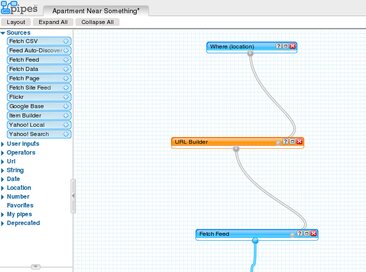
The site through time
Read the old front page here, in one piece, from our own capture: pipes.yahoo.com, 26 May 2008 →
Browse pipes.yahoo.com as it was, via the Internet Archive's Wayback Machine:
Ownership [edit]
Why it shut down [edit]
Official line: Yahoo announced on 4 June 2015 that it was refocusing on search, communications and digital content. Pipes went read-only on 30 August 2015 and shut down on 30 September 2015.
Our analysis: Pipes was brilliant and had no business model. It cost Yahoo money, produced no revenue, and belonged to none of the three areas the company said it was concentrating on. It is the standard fate of a beloved tool inside a company under pressure.
History [edit]
Wires and boxes
Pipes opened in beta on 7 February 2007, built by Pasha Sadri, Ed Ho, Jonathan Trevor, Ido Green and Daniel Raffel. Its creators described it as a hosted service for remixing feeds and creating data mashups in a visual programming environment, and said the name paid tribute to Unix pipes, which let you chain small tools together on a command line.
The interface was a canvas. You dragged modules onto it, a feed fetcher, a filter, a sort, a translator, a regular expression, a location extractor, and connected their outputs to the next module's inputs with wires. The result was a working program that published as an RSS feed, JSON, or a web page, without writing a line of code and without hosting anything.
People used it for real work. Newsroom monitoring, job aggregation, translating and merging feeds, cleaning up badly formed RSS, geotagging, and thousands of small personal automations that would otherwise have needed a server and a cron job.
Ahead of the market it created
The idea has been repeatedly rebuilt since, and profitably. IFTTT launched in 2011, Zapier in 2012, and Node-RED, Microsoft Power Automate and n8n all descend from the same insight, that connecting services should be visible and should not require code.
Yahoo never charged for Pipes and never worked out how to.
Closed, and not exported
On 4 June 2015 Yahoo announced it was concentrating resources on search, communications and digital content. Pipes was on the list of casualties alongside Yahoo Maps. It went read-only on 30 August, and shut down on 30 September 2015.
There was no proper export. Users could see their pipes but not take them anywhere that would run them, and years of small, carefully built automations stopped when the servers did.
Similar projects
 Parse
500,000 apps had their back end switched off
2011–2017
Parse
500,000 apps had their back end switched off
2011–2017
 Google Gears
Made the web work offline, then handed the idea to HTML5
2007–2011
Google Gears
Made the web work offline, then handed the idea to HTML5
2007–2011
 Firebug
Gave every browser the F12 key, then merged into them
2006–2017
Firebug
Gave every browser the F12 key, then merged into them
2006–2017
 CodePlex
Microsoft's open source home, closed because GitHub won
2006–2017
CodePlex
Microsoft's open source home, closed because GitHub won
2006–2017
 Atom
Killed by an editor built on the framework it invented
2014–2022
Atom
Killed by an editor built on the framework it invented
2014–2022
 Google Code
Google's free host for open source projects, killed by GitHub and by the spammers who moved in when everyone else left
2006–2016
Google Code
Google's free host for open source projects, killed by GitHub and by the spammers who moved in when everyone else left
2006–2016
Sources [edit]
- Yahoo sunsets Yahoo Pipes, an IFTTT precursor, along with Yahoo Maps and more TechCrunch 4 June 2015 [archived]
- Yahoo! Pipes is shutting down Neowin 5 June 2015 [archived]
Last verified: 13 August 2026. Spotted an error? Suggest an edit (corrections with sources are reviewed and applied).