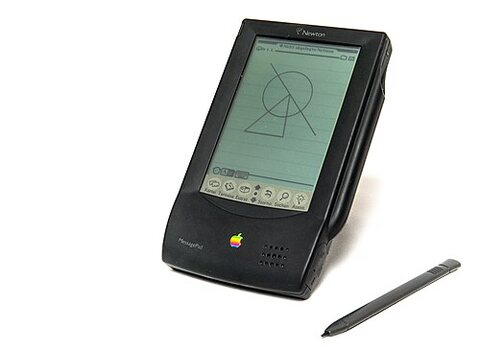
Apple Newton
The handheld that was right, ten years early
The Apple Newton MessagePad launched in August 1993 as the first widely sold personal digital assistant, coining the term PDA. Mocked for its early handwriting recognition and undercut by the cheaper Palm Pilot, it was killed by Steve Jobs on 27 February 1998, months after his return to Apple.
Timeline [edit]
- 1993
-
2 August 1993
Launch
The Newton MessagePad ships
The first mass-market PDA, at $699.
-
26 August 1993
Incident
Doonesbury mocks the handwriting recognition
"Eat up Martha" enters the culture via The Simpsons soon after.
- 1996
-
10 March 1996
Decline
The Palm Pilot arrives
Cheaper and simpler, it takes the market Newton created.
- 1997
-
March 1997
Version
MessagePad 2000 fixes recognition
The best Newton arrives after the reputation is set.
- 1998
-
27 February 1998
Shutdown
Steve Jobs cancels the Newton
The MessagePad 2100 and eMate 300 are discontinued the same day.
How it looked [edit]
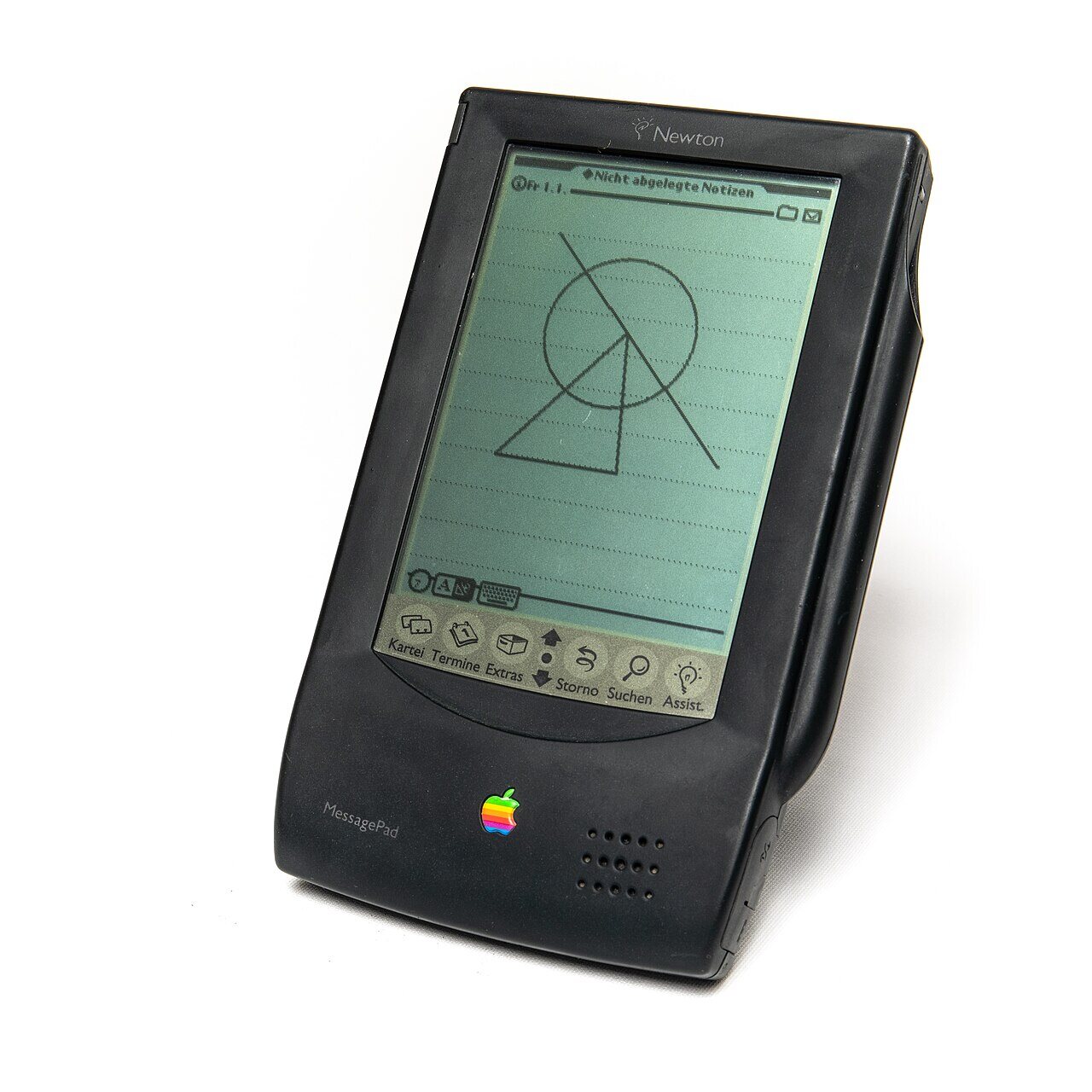
The site through time
Read the old front page here, in one piece, from our own capture: apple.com, 7 July 1997 →
Browse apple.com as it was, via the Internet Archive's Wayback Machine:
Ownership [edit]
Why it shut down [edit]
Official line: Steve Jobs discontinued the Newton platform on 27 February 1998, saying the decision was "consistent with our strategy to focus all of our software development resources on extending the Macintosh operating system".
Our analysis: The Newton's handwriting recognition became a national joke via Doonesbury and The Simpsons before later versions fixed it, and by then the Palm Pilot had taken the market with something cheaper that only tried to do less. Jobs killed it on returning to Apple, and the engineering lived on: the team's ARM investment and touch ideas ran straight into the iPhone.
History [edit]
"Eat up Martha"
Apple's Newton MessagePad went on sale on 2 August 1993 after five years and reportedly over $100 million of development. John Sculley coined "personal digital assistant" for it. It could take handwritten notes, recognise them as text, manage contacts and calendars, beam data by infrared, and act on written commands, in 1993, on a battery-powered handheld.
The handwriting recognition on that first model was not good enough. Doonesbury ran a week of strips mocking it; The Simpsons turned it into a gag where "Beat up Martin" is transcribed as "Eat up Martha", a joke that outlived the product by decades. Later models, especially the MessagePad 2000 and 2100 with a rewritten recogniser, were genuinely excellent, but the reputation had set.
Killed on return
Meanwhile Palm shipped the Pilot in 1996: cheaper, smaller, faster to sync, and honest about being an accessory to a PC rather than a computer in itself. It took the market Newton had created.
Steve Jobs, back at Apple and cutting relentlessly, ended the Newton platform on 27 February 1998, including the MessagePad 2100 and the eMate 300, the education laptop that had briefly hinted at a very different Apple. Newton's fingerprints are everywhere in what followed: Apple's early investment in ARM, made for the Newton, became a shareholding worth billions, and ARM chips now run every iPhone. Several Newton engineers went on to build the iPhone's software, and the device Apple shipped in 2007 finally did what the Newton had promised.
Similar projects
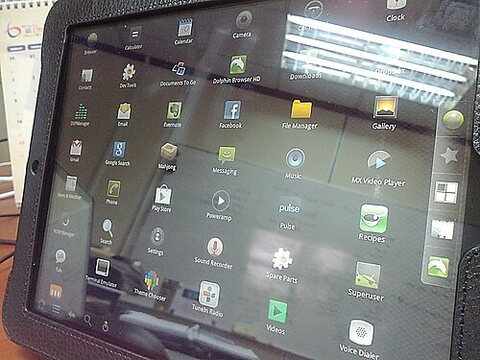 HP TouchPad
Killed 49 days after launch
2011–2011
HP TouchPad
Killed 49 days after launch
2011–2011
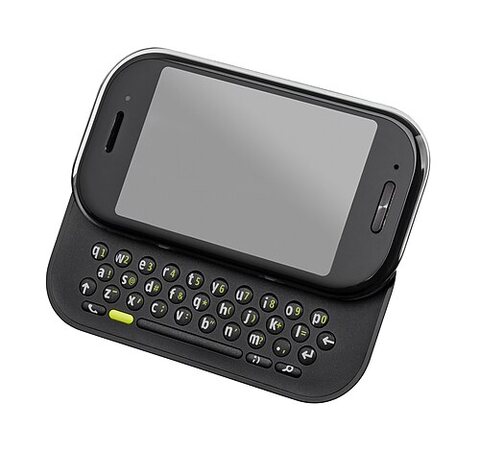 Microsoft Kin
Dead in 48 days
2010–2011
Microsoft Kin
Dead in 48 days
2010–2011
 Google Nexus
Android the way Google meant it, until Google wanted the whole phone
2010–2016
Google Nexus
Android the way Google meant it, until Google wanted the whole phone
2010–2016
 Nokia Lumia
Nokia's bright Windows Phones, and the bet that took the company down with them
2011–2017
Nokia Lumia
Nokia's bright Windows Phones, and the bet that took the company down with them
2011–2017
 Amazon Fire Phone
Amazon's 3D phone, $199 in July, 99 cents by September, $170 million written off by October
2014–2015
Amazon Fire Phone
Amazon's 3D phone, $199 in July, 99 cents by September, $170 million written off by October
2014–2015
 Palm Pre
The comeback phone that invented the card interface and could not save Palm
2009–2011
Palm Pre
The comeback phone that invented the card interface and could not save Palm
2009–2011
Sources [edit]
- Apple Discontinued the Newton 25 Years Ago Today MacRumors 27 February 2023 [archived]
- Newton MessagePad, Newton OS canceled: Today in Apple history Cult of Mac 27 February 2023 [archived]
Last verified: 11 August 2026. Spotted an error? Suggest an edit (corrections with sources are reviewed and applied).