
WonderSwan
Gunpei Yokoi's last handheld, Bandai's Japan-only Game Boy rival with Final Fantasy remakes and a 30-hour battery
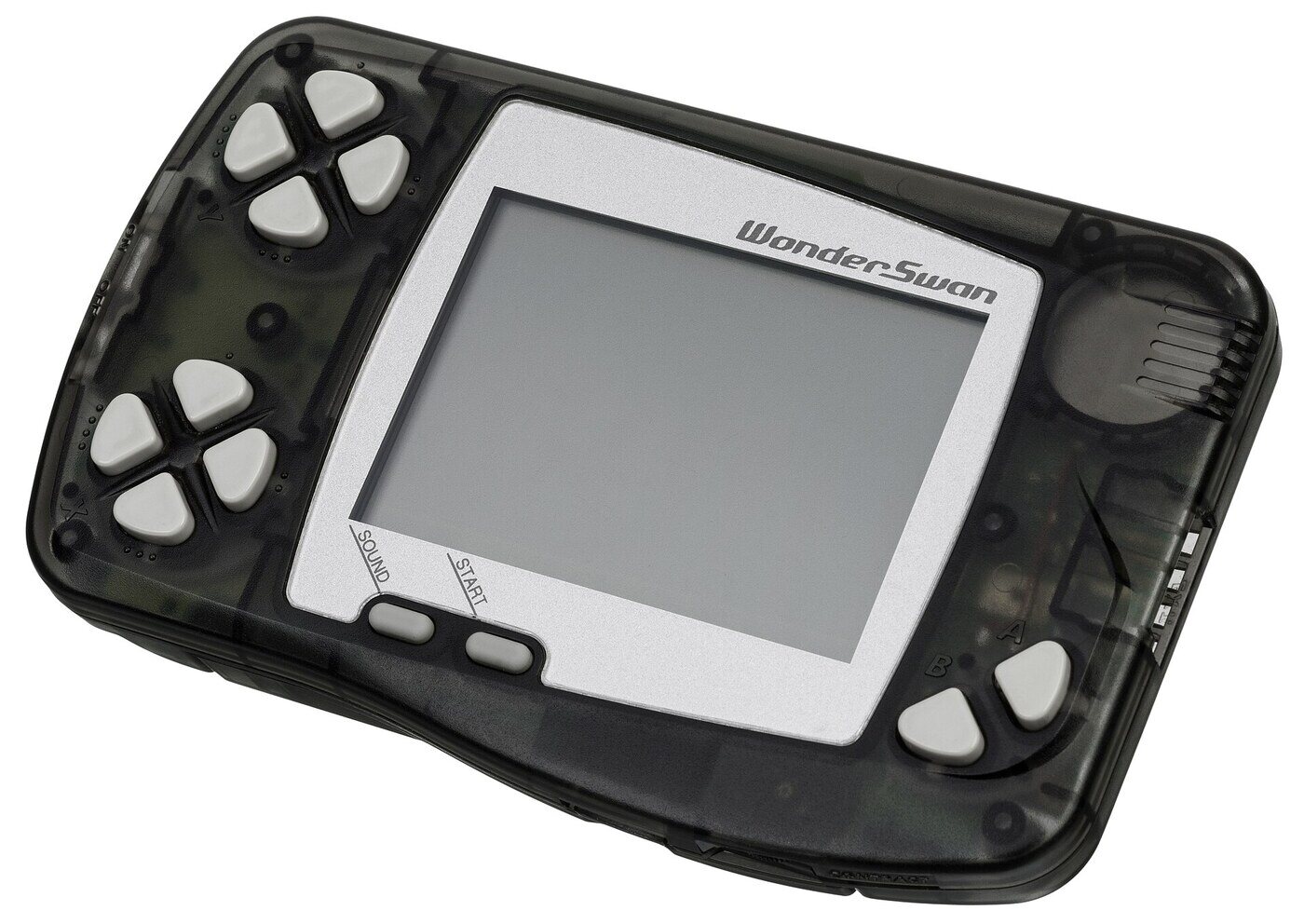
The WonderSwan was a handheld console released by Bandai in Japan on 4 March 1999, designed by Koto Laboratory under Gunpei Yokoi, the creator of the Game Boy, who died in 1997 before it shipped. Cheap, light and running 30 hours on one AA battery, it was followed by the WonderSwan Color on 9 December 2000 and the SwanCrystal on 12 July 2002 and had Final Fantasy remakes and Gunpey as its best-known games. Bandai discontinued the line in 2003 after about 3.5 million sales.
Timeline [edit]
- 1997
-
4 October 1997
other
Gunpei Yokoi dies
The WonderSwan is finished by his team at Koto.
- 1999
-
4 March 1999
Launch
WonderSwan launches in Japan
4,800 yen, monochrome, one AA battery for 30 hours.
- 2000
-
9 December 2000
Version
WonderSwan Color
Square's Final Fantasy remakes; about 8% of the Japanese handheld market.
- 2001
-
21 March 2001
Decline
Game Boy Advance launches
Nintendo takes back the colour handheld market.
- 2002
-
12 July 2002
Version
SwanCrystal
A sharper TFT screen; the last model.
- 2003
-
2003
Shutdown
Bandai discontinues the line
About 3.5 million sold across three models.
How it looked [edit]
The site through time
Browse bandai.co.jp as it was, via the Internet Archive's Wayback Machine:
Ownership [edit]
Key figures [edit]
| Metric | Value | As of | Confidence |
|---|---|---|---|
| Downloads ▲ | 3.5 million | 2003 | Estimated Combined sales of WonderSwan, WonderSwan Color and SwanCrystal |
Confirmed official figures · Reported media, cites a source · Estimated analyst or our estimate
Why it shut down [edit]
Official line: Bandai stopped supporting the WonderSwan line in 2003 after about 3.5 million units across three models. The Game Boy Advance, launched in March 2001, took the market the WonderSwan Color had briefly contested, and Square, whose Final Fantasy remakes had been the platform's biggest draw, went back to Nintendo the same year. Bandai then merged its game business into Bandai Namco and never made another console.
Our analysis: The WonderSwan was designed by the man who created the Game Boy, and it showed: cheap, light, a single AA battery for 30 hours, a clever body that worked upright or sideways. It got to about 8% of the Japanese handheld market, which was more than anyone else managed against Nintendo, on the strength of a Square deal that gave it Final Fantasy I, II and IV. But it was monochrome when colour was arriving, Japan-only, and one exclusive partner away from irrelevance. When Square went back to Nintendo, the machine had no reason to exist.
History [edit]
Yokoi's swan
Gunpei Yokoi left Nintendo in 1996, founded Koto Laboratory and took a contract from Bandai to design a handheld to fight his own Game Boy. He was killed in a road accident in October 1997, and the WonderSwan, finished by his team, launched in Japan on 4 March 1999 at 4,800 yen, less than half the price of a Game Boy Color. It was a monochrome machine, but a smart one: a 16-bit NEC V30 processor, a 2.49-inch screen, two sets of controls so games could run in portrait as well as landscape, a headphone port, and about 30 hours from a single AA battery. Gunpey, a puzzle game named for Yokoi, was the launch title.
The deal that made it was with Square, which was feuding with Nintendo at the time and gave the WonderSwan Color remakes of Final Fantasy I, II and IV plus a Front Mission port. The Color, released on 9 December 2000 at 6,800 yen, took the platform to about 8% of the Japanese handheld market, the closest anyone came to Nintendo in the Game Boy era. Bandai's own Digimon and Gundam licences filled out a library of about 200 games. The SwanCrystal of 12 July 2002 replaced the Color's screen with a sharper TFT panel and was the last model.
Overtaken
The Game Boy Advance arrived on 21 March 2001, in colour and with Nintendo's library, and the WonderSwan's window closed. Square made peace with Nintendo in 2002 and stopped WonderSwan development; a planned Final Fantasy III remake never shipped. Bandai discontinued the line in 2003 with about 3.5 million sold across the three models. It was never released outside Japan and Asia, which is part of why it has become a collector's machine in the West.
The domain today
bandai.co.jp is Bandai's corporate site; the WonderSwan is a museum entry there.
Similar projects
 Ouya
The $99 console Kickstarter wanted to exist
2013–2019
Ouya
The $99 console Kickstarter wanted to exist
2013–2019
 PlayStation Vita
The best handheld nobody supported
2011–2019
PlayStation Vita
The best handheld nobody supported
2011–2019
 Sega Dreamcast
The console that killed its own company
1998–2001
Sega Dreamcast
The console that killed its own company
1998–2001
 Wii U
13.5 million sold, and the ideas all survived it
2012–2024
Wii U
13.5 million sold, and the ideas all survived it
2012–2024
 PlayStation Portable
Sony's first handheld, 80 million sold, the UMD disc, the PSP Go that nobody bought, and a store that closed twice
2004–2014
PlayStation Portable
Sony's first handheld, 80 million sold, the UMD disc, the PSP Go that nobody bought, and a store that closed twice
2004–2014
 Game Gear
Sega's colour handheld, better than the Game Boy on paper and out of batteries in three hours
1990–1997
Game Gear
Sega's colour handheld, better than the Game Boy on paper and out of batteries in three hours
1990–1997
Sources [edit]
- WonderSwan The Centre for Computing History 1 January 2019 [archived]
- Hands on with the WonderSwan Color IGN 16 December 2000 [archived]
- Anniversary: Game Boy creator Gunpei Yokoi's WonderSwan is 25 years old Time Extension 4 March 2024 [archived]
- The Game Boy creator's last handheld was a wonderful little machine Kotaku 11 April 2011 [archived]
Last verified: 16 August 2026. Spotted an error? Suggest an edit (corrections with sources are reviewed and applied).