
Windows Phone
The tiles nobody wrote apps for
Windows Phone was Microsoft's third-ecosystem bet against iOS and Android, launched on 21 October 2010 with its distinctive Live Tiles design. It never escaped single-digit market share, Microsoft wrote off the $7.2 billion Nokia acquisition in 2015, and support for Windows 10 Mobile ended on 10 December 2019.
Timeline [edit]
- 2010
-
21 October 2010
Launch
Windows Phone 7 launches
Metro UI and Live Tiles debut in Europe; US follows in November.
- 2011
-
11 February 2011
Feature
Nokia alliance announced
Nokia abandons Symbian and bets everything on Windows Phone.
- 2012
-
29 October 2012
Version
Windows Phone 8 launches
A move to the NT kernel orphans every existing Windows Phone 7 device, twice burning early adopters.
- 2013
-
3 September 2013
Acquisition
Microsoft announces $7.2B purchase of Nokia's phone business
The all-in moment; deal closes April 2014.
-
December 2013
Peak
Global market share peaks around 3%
Stronger in parts of Europe; invisible in the US and Asia.
- 2014
-
25 April 2014
Acquisition
Nokia deal closes
Microsoft Mobile takes over the devices business it will write off fifteen months later.
- 2015
-
8 July 2015
Incident
Microsoft writes off $7.6B, cuts 7,800 jobs
The Nokia bet is formally abandoned.
- 2017
-
11 July 2017
Decline
Windows Phone 8.1 support ends
Most of the installed base loses updates.
-
8 October 2017
Decline
Microsoft concedes
Joe Belfiore says new features and hardware are over, citing the app gap no subsidy could close.
- 2019
-
10 December 2019
Shutdown
Windows 10 Mobile support ends
Microsoft recommends moving to Android or iOS.
How it looked [edit]

The site through time
Read the old front page here, in one piece, from our own capture: windowsphone.com, 31 May 2011 →
Browse windowsphone.com as it was, via the Internet Archive's Wayback Machine:
Ownership [edit]
Key figures [edit]
| Metric | Value | As of | Confidence |
|---|---|---|---|
| Market share (%) ▲ | 3.4% | December 2013 | Reported Peak global smartphone sales share (analyst figures) |
Confirmed official figures · Reported media, cites a source · Estimated analyst or our estimate
Why it shut down [edit]
Official line: Microsoft's end-of-support FAQ recommended that Windows 10 Mobile users "move to a supported Android or iOS device", ending security updates on 10 December 2019.
Our analysis: Windows Phone died of the app gap: developers would not build for a third ecosystem, users would not buy phones without apps, and no amount of Nokia hardware or Microsoft money could break the loop. The $7.2B Nokia acquisition was written off almost entirely within a year.
History [edit]
The third ecosystem
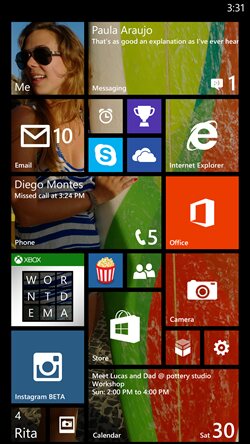
Windows Phone 7 launched in October 2010 with the most original phone UI of its era: Metro's typographic Live Tiles, praised by designers and reviewers alike. Microsoft bet it could be the third ecosystem, sealed an exclusive alliance with Nokia in 2011, and in 2013 announced the purchase of Nokia's entire phone business for €5.44 billion (about $7.2 billion).
The app gap
None of it broke the chicken-and-egg problem: without users, developers skipped the platform (no official YouTube, no Snapchat, a late and abandoned Instagram); without apps, users had no reason to switch. Market share peaked around 3% globally, with only European pockets doing better. In July 2015 Microsoft wrote off $7.6 billion (more than the Nokia purchase) and cut 7,800 jobs; Windows 10 Mobile was a retreat rebranded as a strategy. Support ended on 10 December 2019, with Microsoft's own FAQ telling the faithful to buy an Android or iPhone. The tiles died so that Microsoft could sell Office on the platforms that won.
Similar projects
 BlackBerry OS
The keyboard that ran the world
1999–2022
BlackBerry OS
The keyboard that ran the world
1999–2022
 Windows RT
Windows for ARM tablets that could not run Windows programs
2012–2023
Windows RT
Windows for ARM tablets that could not run Windows programs
2012–2023
 Symbian
Ran most of the world's smartphones, then burned with the platform
1998–2014
Symbian
Ran most of the world's smartphones, then burned with the platform
1998–2014
 Palm OS
The organiser in your pocket that taught phones to be computers
1996–2009
Palm OS
The organiser in your pocket that taught phones to be computers
1996–2009
 Windows Mobile
A tiny Windows with a Start button, reset to zero by its own maker
2000–2012
Windows Mobile
A tiny Windows with a Start button, reset to zero by its own maker
2000–2012
 BlackBerry 10
The reboot that arrived in 2013 and was switched off in 2022
2013–2022
BlackBerry 10
The reboot that arrived in 2013 and was switched off in 2022
2013–2022
Sources [edit]
- Support ending for Windows 10 Mobile in 2019 Microsoft 21 December 2018 [archived]
- Death date: Microsoft will stop supporting Windows 10 Mobile in December 2019 TechRadar 18 January 2019 [archived]
Last verified: 11 August 2026. Spotted an error? Suggest an edit (corrections with sources are reviewed and applied).